
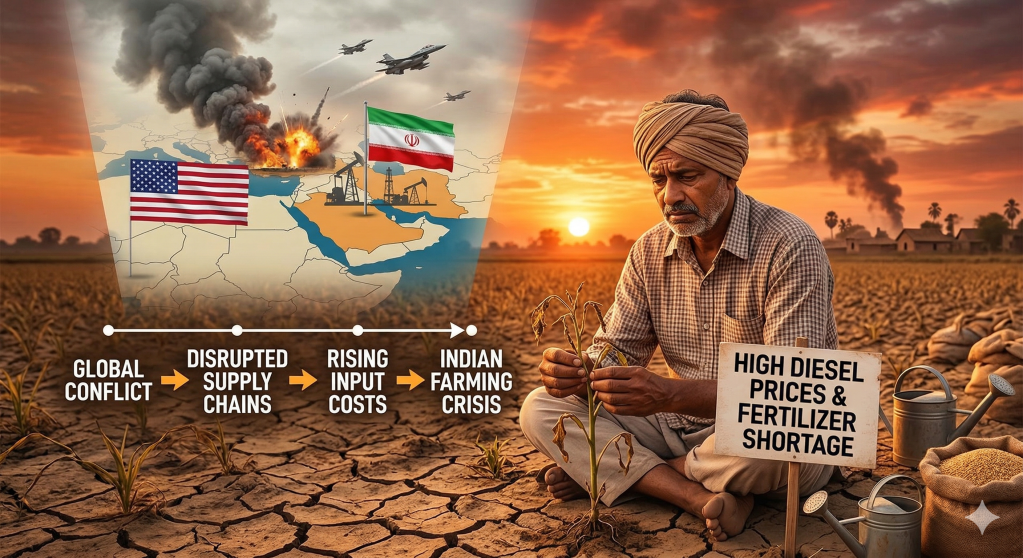
Most people think international conflicts influence oil prices or stock markets.
But as an agriculture student closely observing farm realities, I am noticing something different tensions unfolding thousands of kilometers away are slowly shaping decisions in Indian fields from how much fertilizer a farmer can apply to whether a crop will even be profitable this season.
The Strategic Link Between Conflict and Cultivation
In recent months, while following global political developments alongside agricultural news in India, I found myself wondering how events in West Asia could influence local farming systems.
Modern Indian agriculture is deeply connected with international supply chains. Fertilizers, energy resources, and export markets link farmers to global economic and political systems.
Logistics, Gas, and Geopolitics
Modern agriculture is deeply connected to global supply networks. Nearly 30% of India’s fertilizer imports come from the Middle East, and around 40% of global fertilizer shipments pass through the Strait of Hormuz, a geopolitically sensitive maritime route.
At the same time, fertilizer manufacturing depends heavily on natural gas availability. Global energy instability can increase production costs or even reduce output. For example, domestic production challenges such as gas supply constraints have already affected plant operations in parts of India. These interconnected pressures show how geopolitical events gradually translate into agronomic stress at the farm level.
A Missed Fertilizer Dose Can Cost 20% Yield
Fertilizers are not just inputs they play a crucial role in crop growth at specific stages such as tillering, flowering, and grain formation. However, at harvest time, even small nutrient gaps can translate into reduced yields in staple crops like rice, pulses, and oilseeds.
Yield risks of 15–20% are being discussed in farming circles, highlighting how financial constraints can translate into biological consequences.
Port Delays to Productivity Decline
India exports large quantities of agricultural produce to West Asian countries, particularly basmati rice and spices. When shipping routes become risky or trade slows down, consignments can remain stuck at ports, delaying payments to farmers. This disruption in the income cycle can create a chain reaction affecting productivity, rural spending, and credit dependence.
The Smart Farmer’s Shift
Crises often encourage innovation. Farmers are increasingly exploring integrated nutrient management practices that combine chemical fertilizers with organic sources and biofertilizers. Technologies like nano fertilizers aim to improve nutrient efficiency, while traditional practices such as green manuring continue to support soil fertility. These strategies help reduce dependency on volatile global supply chains.
Understanding the Strategic Risks
- Global conflicts can indirectly influence fertilizer supply, export markets, and farm income in India.
- Modern agriculture is strongly linked with international trade routes and energy markets.
- Rising input costs and supply uncertainty affect cropping decisions and productivity.
- Integrated nutrient management and local innovations can improve farm resilience.
- Building soil-focused, adaptive farming systems is essential for future food security.
Geopolitics Meets Agriculture
For many citizens, geopolitical tensions remain distant headlines. For farmers, they can quietly shape daily decisions that determine crop outcomes and financial stability. As agriculture becomes more globally interconnected, strengthening resilient farming systems may be the most important step towards ensuring stable food production in an uncertain world.
Understanding this connection between geopolitics and farming may be the first step toward designing a more secure and sustainable agricultural future.
