
Introduction
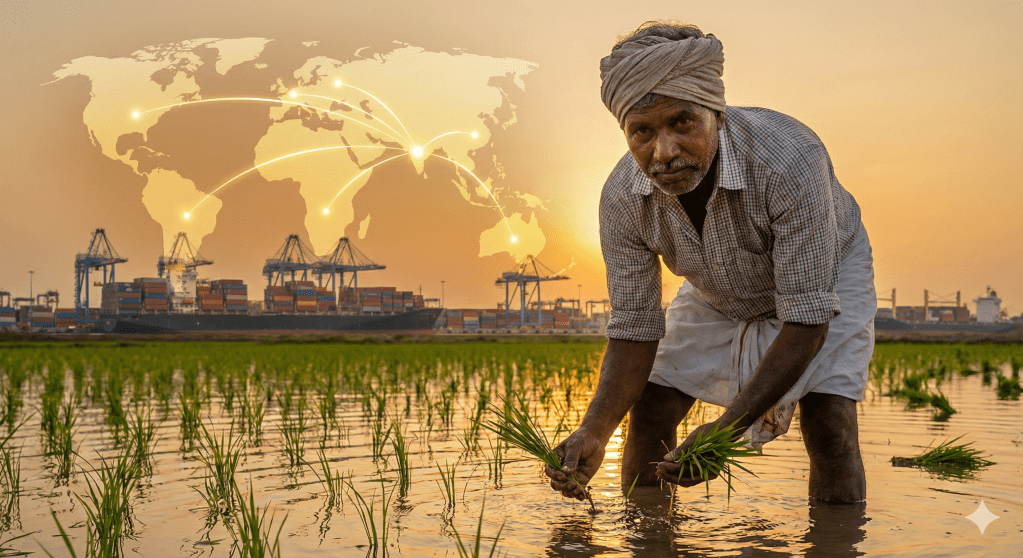
India crossing China in total rice production is not just a headline it is a structural shift in global agriculture. Finalized FAOSTAT 2023 data showed India edging ahead, and the momentum strengthened when the Ministry of Agriculture & Farmers Welfare confirmed that rice production reached 150.18 million tonnes in 2024–25, surpassing China’s estimated 145.28 million tonnes.
For a country that once struggled with food shortages, this is a powerful milestone. But production alone does not define strength. As a student of rice agronomy, I see a deeper question: can this scale be sustained without straining soil, water, and farming systems?
What Exactly Happened?
Total Production Numbers
FAOSTAT 2023 confirmed that India’s paddy output slightly exceeded China’s in total volume. The Ministry’s Final Estimates placed 2023–24 rice production at 137.8 million tonnes (1378.25 LMT – Lakh Metric Tonnes).
The following crop year marked a sharper lead. In 2024–25, production rose to 150.18 million tonnes, firmly widening the gap over China.
This establishes India as the largest rice producer in absolute terms.
Area vs Yield
The numbers, however, need context.
- India cultivates approximately 45–46 million hectares under rice.
- China cultivates about 30 million hectares.
- China’s average yield stands near 7.1 tonnes per hectare.
- India’s national average varies: broader consolidated data often cite 3.0–3.5 tonnes per hectare, while high-performing states like Punjab report 4.8–5.0 tonnes per hectare.
The gap is clear. China produces more per hectare. India produces more because it cultivates more land though productivity is improving.
Production vs Productivity: The Structural Difference
Yield Efficiency
Yield (output per unit area) reflects efficiency of land use. China’s higher yield is supported by:
- Large-scale hybrid rice adoption
- Strong mechanization
- Advanced irrigation and water control systems
India’s productivity has improved, but performance varies sharply across states. Rainfed regions still lag behind irrigated belts.
Hybrid Adoption and Input Use
Earlier assessments placed hybrid rice adoption in India below 10–12%. That picture has changed.
Recent 2024–25 data indicate that approximately 6.5 million hectares are under hybrid rice, and nearly 45% of rice farmers are using hybrid seeds, supported by National Food Security Mission initiatives and public–private partnerships.
This signals a transition. India’s growth is no longer purely area-driven. Technology especially hybrid seeds is increasingly contributing. However, adoption is uneven, and yield stability still varies by region.
How Rice Became India’s Dominant Crop
Agro-Climatic Suitability
Rice fits India’s agro-climatic conditions. Warm temperatures (20–35°C), monsoon rainfall, and the ability of rice to grow in waterlogged soils make it adaptable across diverse regions.
Paddy cultivation (rice grown in flooded fields) allows weed suppression and stable yields under irrigation.
Cultural and Dietary Importance
Rice feeds more than half the population. In many eastern and southern states, it is central to daily meals and cultural practices. Consumption patterns reinforced production priorities.
Irrigation Expansion
Post-independence expansion of canals and groundwater irrigation reduced production risk. With irrigation assurance, farmers preferred rice over more uncertain crops.
Role of the Green Revolution
High Yielding Varieties (HYVs)
The Green Revolution introduced High Yielding Varieties (HYVs – varieties that respond strongly to fertilizers and irrigation). These varieties transformed rice productivity in irrigated zones.
Fertilizer Responsiveness
HYVs responded strongly to nitrogen, phosphorus, and potassium (NPK). Input use intensified, and yields rose. However, dependency on external inputs also increased.
Institutional Support
Assured procurement systems reduced market uncertainty. Rice, alongside wheat, became central to India’s food security strategy.
Rice and Political Economy
MSP System
The Minimum Support Price (MSP – government-declared procurement price) provides income security in major rice-producing states.
FCI Procurement
The Food Corporation of India (FCI) purchases large quantities for buffer stocks. This stabilizes national food supply and farmer income.
Public Distribution System (PDS)
Rice is a core component of the Public Distribution System (PDS – subsidized food supply mechanism). Production is therefore directly tied to national welfare policy.
Rice is not just a crop. It is part of the state’s food security architecture.
India as a Global Rice Export Power
Export Share
India’s global presence is significant. Its share in world rice exports averaged 38.6% during 2021–23, rising to about 46% in 2023.
This makes India the most influential player in global rice trade.
Basmati vs Non-Basmati
- Basmati rice serves premium international markets.
- Non-basmati rice supports bulk exports to food-deficit regions.
Export Restrictions (2023–24)
Temporary restrictions on certain non-basmati categories were introduced to stabilize domestic prices. This demonstrated how strongly global markets depend on Indian supply.
Paddy Cultivation in Brief
Growth Stages
Rice follows defined growth stages:
- Nursery
- Transplanting
- Tillering (side shoot development)
- Panicle initiation (flower formation)
- Grain filling
Each stage has specific water and nutrient requirements.
Water Requirement
Rice typically requires 1200–2000 mm of water per season, depending on irrigation system and ecology. Flooded conditions create anaerobic soil (low oxygen environment), affecting nutrient transformations and methane formation.
Nutrient Requirement
Rice is nitrogen-intensive. Excess nitrogen can reduce nutrient balance and increase environmental losses.
Hidden Costs of Intensive Paddy Systems
Water Stress and Groundwater Depletion
In several districts of Punjab and Haryana, groundwater extraction exceeds natural recharge, leading to “over-exploited” classifications.
Expanding rice into semi-arid zones has long-term water implications.
Soil Degradation and Nutrient Imbalance
NPK Imbalance
Excess nitrogen relative to phosphorus and potassium disturbs soil nutrient balance.
Micronutrient Deficiencies
Zinc deficiency is increasingly reported in intensive rice systems.
Soil Organic Carbon Decline
Repeated puddling and residue removal reduce soil organic carbon (SOC – stored organic matter in soil), affecting soil structure and long-term productivity.
Environmental Concerns
Methane Emissions
Flooded rice fields emit methane (CH₄ – a potent greenhouse gas) through anaerobic decomposition. Globally, rice contributes about 8–12% of agricultural methane emissions.
Stubble Burning
Rice–wheat systems generate large residues. In some regions, residues are burned, contributing to air pollution.
Agrochemical Runoff
Excess fertilizer and pesticide use can contaminate nearby water bodies.
Monocropping and System Instability
Rice–Wheat Cycle
Continuous rice–wheat rotation reduces biodiversity and increases pest pressure.
Yield Plateau
In some high-input regions, yields are stagnating despite rising input use indicating diminishing marginal returns.
Crowding Out Pulses and Millets
Cropping Pattern Distortion
Strong procurement incentives favor rice over pulses and millets.
Protein Security Concern
Pulses are primary plant protein sources. Reduced area under pulses affects nutritional balance.
Economic Incentives vs Ecological Balance
Farmers respond logically to price assurance. Diversification depends on stable markets and infrastructure.
Sustainable Pathways Forward
Water-Smart Technologies
Alternate Wetting and Drying (AWD)
AWD allows periodic soil drying between irrigations, reducing water use and methane emissions.
Direct Seeded Rice (DSR)
DSR eliminates transplanting and puddling, reducing water and labor requirements. Weed management becomes critical.
Laser Land Leveling
Improves water distribution efficiency and reduces irrigation losses.
Soil-Centered Approaches
Integrated Nutrient Management (INM)
INM combines chemical fertilizers with organic inputs to maintain long-term soil fertility.
Biofertilizers
Biofertilizers (beneficial microbes that enhance nutrient availability) reduce chemical dependency.
Crop Rotation
Including legumes improves biological nitrogen fixation (natural nitrogen addition through symbiotic bacteria).
Diversification Within Existing Support Systems
Millets Revival
Millets require less water and tolerate drought better than rice.
Pulses Integration
Incorporating pulses strengthens soil nitrogen and enhances resilience.
Intercropping Models
Diversified rice-based systems improve ecological stability without eliminating rice from the system.
Conclusion
India’s rise to the top of global rice production reinforced by the 150.18 million tonne output in 2024–25 is a measurable achievement.
The growth reflects scale, improving hybrid adoption, institutional support, and export strength.
But production dominance does not automatically mean system resilience. Water pressure, soil degradation, and monocropping risks remain structural challenges.
The next phase of India’s rice story will not be defined by how much more it can produce but by how intelligently it can sustain what it already leads.
