
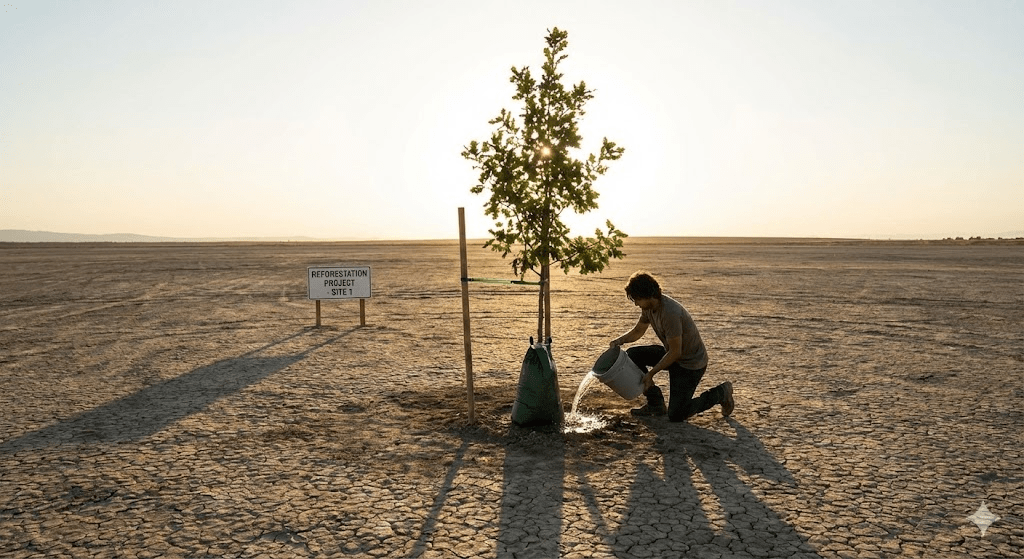
Empty land changes slowly. What begins as exposed soil soon hardens, cracks, and loses its ability to breathe. But the moment a tree takes root, something subtle shifts. The soil softens. Air returns. Life begins moving again under the surface. It’s a reminder that one tree is not just shade or beauty it’s a spark of metabolism for the land itself.
Why Soil Comes Alive Only When Something Grows
Soil is not just a layer of dirt. It is a living system full of microbes, fungi, and tiny organisms constantly breaking down, building up, and transforming matter. But like a kitchen without ingredients, bare soil slowly stops working. Without organic matter and living roots, microbial life slows, oxygen disappears, and the soil begins to seal itself shut.
Tree roots interrupt that silence.
They release tiny compounds sugars, amino acids, organic acids that feed microbes and activate the soil’s biological engine. These root exudates act like daily meals, keeping microbial communities active and diverse. The roots also create small channels in the soil, allowing air and water to enter easily. The ground stays porous instead of collapsing into a compact block.
When land remains bare, every raindrop hits the surface directly. Soil particles press tightly together, water struggles to enter, and the top layer eventually forms a hard crust. Over time, this crust breaks down into dust a sign that the land is losing its ability to host life.
What Climate Trends Are Revealing
As the planet warms, the condition of open land is changing faster than before.
NASA’s 2024 Land Vitality Report noted that a significant portion of global soil carbon loss occurs in areas with minimal or no vegetation. India’s Desertification and Land Degradation Atlas (2023 update) shows that over 29% of land is degraded, and exposed soil is one of the major drivers.
These barren spaces heat up quickly. NOAA’s 2024 climate summary highlighted that areas with tree cover remained 2–4°C cooler during intense heatwaves. Bare patches not only warm faster but also lose moisture rapidly, making the soil brittle and prone to erosion.
As rainfall becomes more unpredictable with heavier downpours now common across South Asia exposed soil struggles to absorb water. Instead of soaking in, rain washes the top layer away, leaving behind a thinner, weaker surface.
The IPCC’s 2023 report warns that compacted soils can release up to 30% more CO₂, simply because microbial activity collapses and carbon has no stable place to stay. India’s 2024 heatwaves pushed soil temperatures higher than usual, causing faster organic matter breakdown and accelerating the shift from soil to dust.
In this warming world, the presence or absence of vegetation decides whether land heals or declines.
Why Trees Make Such a Big Difference
A tree does more than stand upright in the landscape.
It anchors the soil, shields it from direct heat, and feeds the underground network of life. Its roots store carbon, hold the soil during heavy rains, and guide moisture deeper into the ground. Even a single tree can stabilize microclimates cooling the air, protecting nearby soil, and creating a small but meaningful pocket of resilience.
As roots spread, they create pathways for water. As leaves fall, they form mulch. As microbes feed on root exudates, they activate nutrient cycles that keep soil fertile. A barren patch with one tree becomes a slowly recovering ecosystem.
Key Things to Remember
- Tree roots keep soil biologically active through natural compounds they release.
- Bare land becomes compact, lifeless, and eventually breaks into dust.
- Recent climate data shows degradation rising sharply across India and globally.
- Trees cool the land, store carbon, and protect soils from erosion.
- Planting even one tree in an empty space begins the process of soil revival.
A Thought That Guides This Conversation
Wangari Maathai once said, “When we plant trees, we plant the seeds of peace and hope.”
A Quiet Closing Reflection
Empty land is easy to ignore until it begins to fail. But every patch of bare earth is a reminder of what’s missing a root, a shadow, a small thread of life holding the soil together. Planting a tree in such a space isn’t just an act of greening. It’s a way of waking up the ground beneath us, one breath of soil at a time.
