
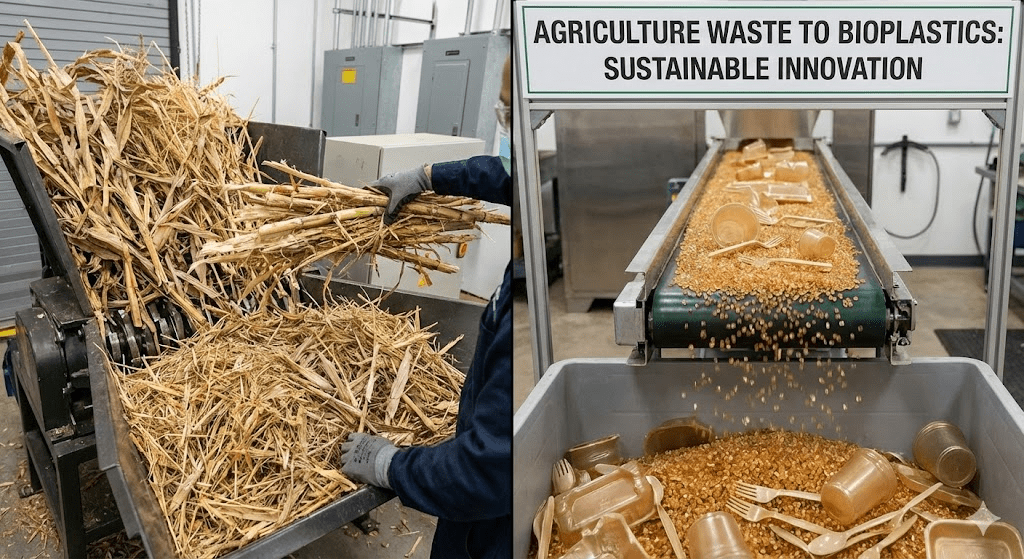
It’s easy to think of agricultural waste as something to discard a heap of husk here, a pile of stalks there. But the more we look closely, the more we realise these leftovers carry energy, nutrients, and climate solutions we often underestimate. What we call “waste” may actually be one of the strongest tools for circular, climate-smart farming.
Seeing Agricultural Waste in a New Light
Every farm creates residues: straw, leaves, shells, dung, and crop remains. They look ordinary, almost invisible in daily routines. But just like used coffee grounds that can feed plants or reduce odour, agricultural residues hold hidden value. Inside them lies stored carbon, organic matter, and energy quietly waiting to be used.
When handled the right way, these materials become fuel, fertiliser, packaging, or soil enhancers. They close loops instead of opening new waste streams. And they remind us that nature rarely leaves anything without purpose.
How Waste Turns Into Energy
Bio-energy simply uses farm leftovers as fuel instead of letting them burn in open fields.
When residues or manure break down without oxygen, they release biogas a mix of methane and carbon dioxide that can cook meals, warm water, or power small machinery. It’s the same natural process that decomposes organic matter, only captured and used meaningfully.
Some wastes become briquettes compact blocks made from rice husk, coconut shells, or sawdust. They burn slowly and replace charcoal or firewood. Others, like molasses or starchy residues, ferment into bioethanol, using the same principles we see when yeast turns sugar into dough.
Different wastes, one simple truth: nature stores energy, and we’re learning how to unlock it.
When Waste Becomes Bioplastics
Bioplastics might sound technical, but the idea is grounded in everyday life.
Just as milk thickens into curd or dough becomes soft and stretchy, plant materials transform when processed gently.
Agricultural residues often contain starch or cellulose natural building blocks that can be shaped into packaging. Corn starch, potato peels, banana fibres, and sugarcane bagasse can all be turned into cups, films, trays, or carry bags. These materials decompose naturally, returning to the soil without leaving behind microplastic footprints.
What once had no value suddenly becomes a climate-friendly material.
Why This Matters for the Climate
Open burning of crop residues is still widespread, especially during peak harvest seasons. And the climate cost is high.
NASA’s 2023 satellite readings showed that stubble burning pushed particulate pollution sharply upward during peak weeks in northern India. At the same time, NOAA observed methane levels reaching new highs in 2023–2024 partly from unmanaged agricultural waste.
When residues are burnt or left to rot in the open, the carbon stored inside them escapes as methane or smoke.
But when the same materials enter biogas plants, they release energy in a controlled way. Clean fuel replaces firewood or fossil energy, while the leftover slurry enriches soil instead of polluting it. Reports in 2024 noted that India’s network of small and medium biogas units prevented millions of tonnes of CO₂-equivalent emissions simply by diverting dung and straw from open dumping.
And on the materials side, bioplastics derived from farm waste reduce reliance on petroleum-based plastics which are now leaving microplastics in soils across Asia. Early 2024 studies showed microplastic levels rising in agricultural topsoil, affecting microbes and nutrient cycles. Bioplastics break this cycle by decomposing naturally.
Waste becomes part of the solution, not the problem.
Simple Takeaways That Stay With Us
- Agricultural residues hold energy, nutrients, and carbon.
- Bio-energy cuts methane leaks and reduces open burning.
- Bioplastics made from crop waste prevent microplastic pollution.
- Circular use of waste supports farmers financially and ecologically.
- Treating residues as resources strengthens climate resilience.
A Line That Fits This Story
Wangari Maathai once said, “It’s the little things citizens do that will make the difference.”
A Quiet Closing Reflection
We often step over piles of straw, husk, or shells without thinking twice. But these so-called leftovers remind us of a deeper truth nothing in nature is truly waste. Everything has a cycle, a purpose, a way back into the system.
When rice husk becomes clean fuel, or coconut shells transform into biodegradable packaging, the idea of waste begins to look outdated. It feels more like a missed opportunity one we are finally learning to reclaim.
In a climate-stressed world, every residue becomes a resource. Every by-product becomes a doorway to circular farming. And the more we value what we once ignored, the stronger and more resilient our food systems become.
Because the real shift begins not with technology, but with seeing familiar things differently especially the ones we used to call “waste.”
