
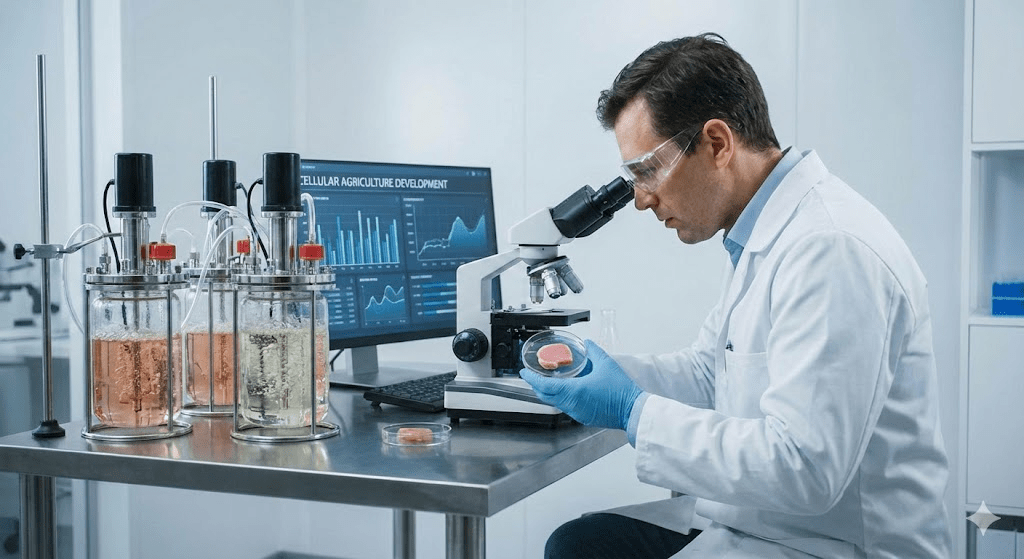
It’s a strange thought at first meat, milk, or protein made without animals or large fields. But this idea is slowly moving from research labs into real conversations about the future of food. And as the climate grows more unpredictable, it’s becoming important to understand how this shift might shape agriculture.
The Quiet Rise of Food Grown from Cells
Cellular agriculture is simple at its core. Instead of raising a whole animal, only the cells needed for a product are grown under controlled conditions. A muscle cell becomes meat. A milk-producing cell becomes dairy. Microbes can be guided to make proteins that replace eggs or cheese.
It’s a bit like fermentation when curd forms because bacteria are given the right environment. Here, cells grow when provided nutrients, warmth, and sterility. Bioreactors do what our kitchen vessels do, just at a larger scale and with more control.
What makes this approach interesting is not the technology itself, but what it avoids: the long chain of feed production, water consumption, land use, and manure management that traditional livestock requires. It compresses a process that usually stretches across fields, sheds, and seasons.
Why Cellular Agriculture Is Part of the Bigger Climate Conversation
In the past few years, climate indicators have grown sharper. Heatwaves, erratic rainfall, and rising methane levels are now part of the everyday discussions around farming.
Livestock remains a major contributor to emissions globally, especially methane a gas that warms the planet far faster than carbon dioxide. Recent climate reports from 2023–2024 consistently highlight methane as one of the biggest levers for slowing warming in the near term.
This is where cell-based foods enter the climate discussion. They remove the need for enteric fermentation the biological process inside animals that produces methane. Some studies from 2023 suggest that if powered by cleaner energy, cultivated meat or precision-fermented proteins could significantly reduce methane emissions and require only a fraction of the land used by livestock.
Using less land means fewer forests cut, fewer grasslands converted, and more natural ecosystems left intact ecosystems that quietly store carbon.
But there’s an important nuance. Growing cells in bioreactors requires energy. If that energy comes from fossil fuels, then carbon dioxide emissions stay high even if methane drops. So the climate benefit depends on how quickly grids shift to renewable power.
Cellular agriculture isn’t automatically climate-friendly but it can be, if paired with clean energy.
A Technology That Reduces Pressure on Land
One of the most compelling aspects of this system is its relationship with land.
Cultivated protein doesn’t need vast fields or grazing areas. Some estimates from 2024 suggest that cell-based meat could use far less land even up to 90–95% less in certain comparisons. For regions struggling with soil degradation, water stress, or shrinking arable land, this matters.
When food production requires less land, farmers can diversify. More space becomes available for pulses, millets, fruits, and soil-restoring crops. It opens pathways for agroforestry, carbon farming, or regenerative practices that rebuild soil rather than exhaust it.
Cellular agriculture doesn’t replace farming it adjusts the pressure on it.
What This Means for Farmers
The future of farming won’t be a simple switch between old and new systems. It’s more likely a shared landscape where traditional agriculture, regenerative practices, and cell-based protein coexist.
Livestock won’t disappear. Rural livelihoods won’t vanish. But certain segments like industrial meat or high-input dairy may shift over time as alternative proteins become more accepted.
For farmers, this could mean:
- more opportunities to grow crops for local soil health rather than feed for industrial systems
- reduced pressure on land and water
- space to shift toward higher-value, climate-resilient crops
- new roles in supplying ingredients for fermentation-based foods
Instead of competing with farmers, these technologies might free them from practices that have become unsustainable under rising heat and unpredictable weather.
A Few Simple Takeaways
- Cellular agriculture produces food directly from cells, reducing the need for livestock.
- It can significantly cut methane emissions if powered by clean energy.
- It uses much less land, easing pressure on ecosystems and soil.
- Its success depends on renewable energy, affordability, and public acceptance.
- Farming won’t disappear it will adapt, diversify, and reshape its role.
A Thought from the Past That Still Fits Today
Norman Borlaug once said, “You can’t build a peaceful world on empty stomachs.”
A Quiet Question to End With
If food can now grow from cells, not animals or fields, how will our idea of farming evolve in the next 20 years? Maybe the real challenge isn’t choosing one system over another it’s learning how both can work together to protect the planet while feeding everyone.
