
It was one of those bus ride back from college the kind where the road feels endless, and my thoughts start drifting like clouds over the fields outside. I had just slipped into my usual window seat, the breeze nudging through the open pane. I wasn’t in the mood for music. My mind was busy restless, really replaying a mix of lectures, news headlines, and half-formed questions that had been haunting me for decades.
Then, as the bus rolled out of campus, my Eco-Physiology professor climbed aboard and took the seat beside me. He greeted me with a gentle nod, that calm, observant look he always carried in class.
We sat quietly for a while. I wasn’t sure if I should speak or let him rest. But the silence only made the question louder in my head a question that had been building up quietly every time I read about crop failures, erratic monsoons, or farmers abandoning their fields.
“Sir… about climate change. Can we actually do something? Is it even possible?”
He looked at me, calm as ever, and said, “We can. But it takes time.”
I told him I think about it a lot. About farmers struggling, about rainfall becoming a gamble, about the soil drying faster than we can fix it. We talked for a while and then, almost casually, he said:
“ICAR just released two new rice varieties. Genome-edited. If widely adopted, they could cut greenhouse gas emissions by nearly 20%.”
That one sentence stuck with me.
I went home, opened my laptop, and started digging. What I found was fascinating a breakthrough that wasn’t being talked about enough. Two rice varieties that could quietly transform how we farm and how we fight climate change.
And right then, I knew. This story needed to be told.
The Rise of Climate-Smart Rice
Let’s be real: rice isn’t just food in India it’s a lifeline. More than half the population depends on it. Farmers grow it across 44 million hectares. But the future of rice and food security is under serious threat from climate change.
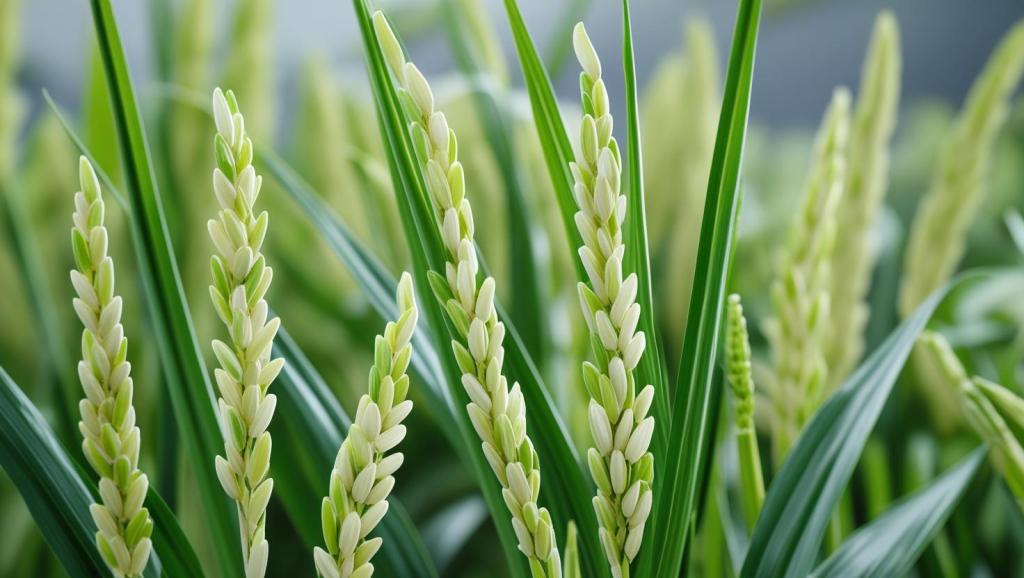
DRR Dhan 100 (nicknamed Kamala) and Pusa DST Rice 1 two new rice varieties developed by India’s premier research institutions under ICAR.
These are not GMOs. They’re genome-edited using CRISPR a tool that makes tiny, precise edits in the plant’s own DNA without inserting foreign genes. The result? Two varieties that are higher yielding, stress-resilient, water-saving, and environmentally friendly.
Smart Seeds, Smarter Science: The Story Behind Kamala and Pusa DST
Kamala – The Yield Booster
Developed by ICAR-IIRR in Hyderabad, Kamala is based on Samba Mahsuri a popular rice known for its cooking quality. Scientists edited the OsCKX2 gene, which normally reduces grain formation. By turning this gene off, they unlocked more grains per panicle and stronger stems to support them.
The result? Up to 19% higher yield, earlier maturity, and better performance under low fertilizer conditions.
Pusa DST Rice 1 – The Stress Rescuer
Created at ICAR-IARI, New Delhi, this variety tackles drought and salt stress. Scientists knocked out the DST gene, which usually suppresses the plant’s natural stress responses.
With this gene gone, Pusa DST develops broader leaves, fewer stomata (to reduce water loss), and improved physiological strength under harsh conditions. It performs especially well in saline, alkaline, and drought-prone soils exactly where traditional varieties tend to fail.
Real-World Impact: What the Field Trials Say
Field trials under AICRP in 2023–24 showed strong performance:
- Kamala: 19% higher grain yield than Samba Mahsuri, with yields reaching up to 9 t/ha under optimal conditions.
- Pusa DST: Yield increases ranged from 9.66% to 30.4% under stress especially in coastal saline and inland alkaline soils.
Both retained the grain quality and maturity periods of their parent lines, making them familiar yet improved options for farmers.
Faster to Harvest, Kinder to the Planet
Kamala matures 15 to 20 days earlier than its parent. That shorter growth cycle brings real advantages:
- Less irrigation and energy use
- Earlier harvest to escape pests and drought
- Potential for double cropping
- Lower methane emissions due to reduced field flooding
Pusa DST Rice 1 keeps the early maturity of MTU-1010 (125–130 days), making it ideal for both kharif and rabi seasons especially in double-cropping systems.
Tackling Climate Change Through Rice
Rice farming is both a victim and contributor to climate change.
- It suffers from water scarcity, heat stress, and salinity.
- But it also contributes to global warming through methane emissions from flooded fields.
These two varieties turn the problem into a solution.
Kamala:
- Early maturity reduces flooding time → less methane
- Better nitrogen-use efficiency → fewer emissions
- Strong root system → resilience under low-input farming
If adopted across 5 million hectares, Kamala could save 7,500 million cubic meters of water and cut methane emissions by up to 20%.
Pusa DST:
- Reduced stomatal density conserves water
- Enhanced tolerance to drought and salinity means less crop loss
- Brings degraded lands (like saline soils) back into production without deforestation
Together, these varieties represent a shift toward climate-smart agriculture delivering more food with fewer resources, and cushioning farmers against the shocks of a changing climate.
Prosperity in the Panicle: A New Deal for Farmers
This is not just about science it’s about farm economics.
- Kamala’s 19% yield gain can significantly boost income per hectare.
- Pusa DST stabilizes yields in stress-prone areas where crops often fail.
- Both reduce the need for water, fertilizer, and recovery costs from crop losses.
- Farmers growing these varieties may also gain flexibility to grow an additional crop or shift some land to pulses or oilseeds.
As Agriculture Minister Shivraj Singh Chouhan noted, higher yields on less land could enable India to diversify crops without compromising food security a win for farmers and national resilience.
From Soil to Solution: What Kamala and Pusa DST Teach Us
When I sat on that college bus that evening, I didn’t expect anything profound. It was just another ride home same road, same dust, same tired silence after a long day of classes.
But somewhere between the hum of the engine and the passing fields, I found myself asking a question that had been quietly weighing on me for weeks. “Can we really do something about climate change?”
I wasn’t expecting a clear answer. But what I got was a thread a simple mention of two rice varieties. Kamala. Pusa DST. I followed that thread all the way home, onto my laptop, and deep into research papers and field trial reports. And what I found surprised me.
These weren’t just upgraded crops. They were stories of science woven into the soil. Of people researchers, farmers, institutions working quietly to reshape what’s possible. They were proof that climate resilience doesn’t have to be loud or complicated. Sometimes, it begins in the most familiar place a paddy field.
Kamala and Pusa DST aren’t just about higher yield or better stress tolerance. They’re about holding onto something precious the ability to grow, to adapt, to endure.
