
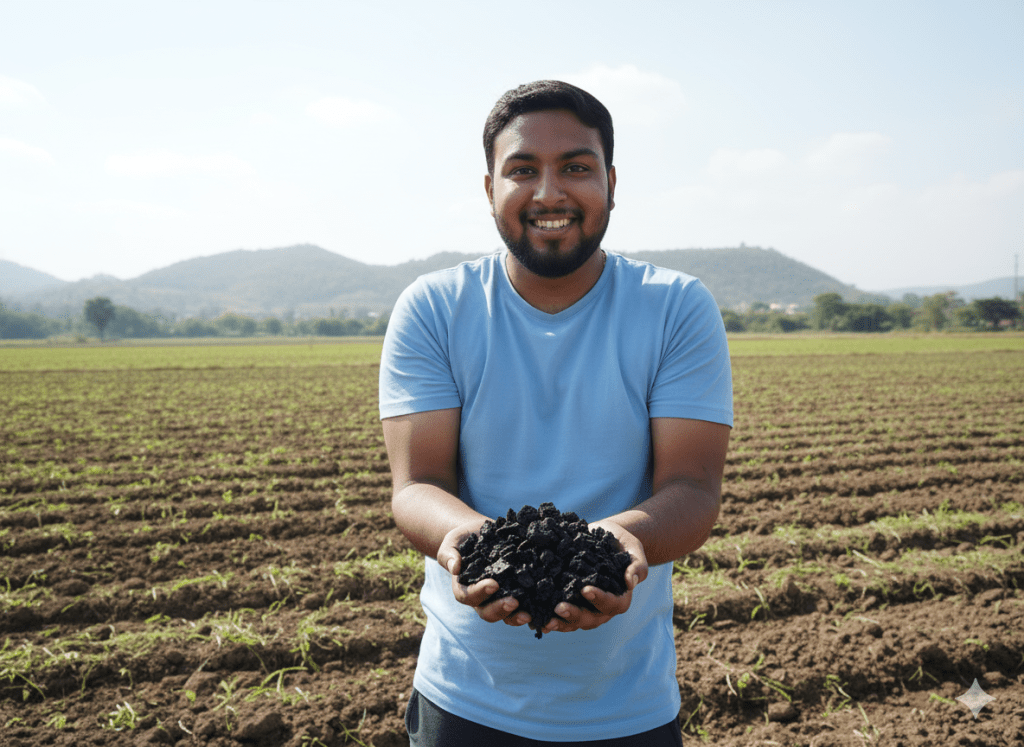
An ancient idea, modern science, and a spark of curiosity that’s how I discovered biochar, and why I believe it might change farming in India.
The Corridor Question That Sparked It All
First semester of B.Sc. Agriculture, subject: Agricultural Heritage. Our professor was wrapping up a lecture on plant nutrients when one word made me sit up: biochar.
It sounded mysterious, almost magical. As she walked out, I couldn’t hold back. In the corridor, I asked:
“Ma’am, could you please tell me more about biochar?”
She smiled and said: “It’s a carbon-rich material made by heating organic waste. Instead of polluting, it captures carbon and helps fight climate change.”
That one line stayed with me. It sent me down a rabbit hole articles, YouTube explainers, even calls with people in India who actually make biochar. And slowly, I realized: this wasn’t just another farming input. This was a soil healer. A climate tool. A farmer’s ally.
The Black Gold Hiding in Crop Waste
So what exactly is biochar?
It’s a carbon-rich, black material made by heating crop residues, wood, or manure in low oxygen a process called pyrolysis.
It’s not ash. It’s stable carbon, lightweight like charcoal, but inside, it’s like a sponge full of tiny pores. Those pores hold water, trap nutrients, shelter microbes, and even lock away toxins.
The real magic? Biochar stores carbon for centuries instead of letting it escape back into the air as CO₂. In short: it’s not just soil-friendly. It’s climate-friendly too.
Why India Needs Biochar Now
Decades of fertilizer-heavy farming have drained our soils. Organic matter is down, water is scarce, and crop residue burning fills the air with smoke every winter.
Biochar flips that story:
- Crop waste isn’t burnt it’s transformed.
- Degraded soils aren’t abandoned they’re revived.
- Carbon isn’t emitted it’s buried back safely in the ground.
One estimate suggests that if India converted even a fraction of its crop residues into biochar, we could sequester up to 53% of our annual greenhouse gas emissions. Imagine that waste becoming one of our biggest climate solutions.
The Science Made Simple
Ever wondered how biochar actually works? Think of it in three layers:
1. Chemistry boost
Most biochars are alkaline. In acidic soils like the red soils of South India they act like an antacid, balancing pH and making nutrients like phosphorus more available. They also increase the soil’s cation exchange capacity (CEC), which basically means nutrients stick around instead of being washed away.
2. Physics boost
Those pores act like water tanks. Trials in Tamil Nadu showed soil moisture rising by 11% after adding Prosopis wood biochar. That’s a big deal for drought-prone farms.
3. Biology boost
Biochar is like free housing for microbes. It gives bacteria and fungi safe shelter to multiply and support crops. In India, microbial biomass carbon has jumped 15–70% in biochar-treated soils.
So it’s not hype. It’s chemistry, physics, and biology teaming up to rebuild soil health.
The Climate Connection We Can’t Ignore
Here’s where biochar really shines. Normally, crop residues left to rot release CO₂, methane, and nitrous oxide gases that trap way more heat than CO₂ alone.
But pyrolysis changes the game:
- Carbon is locked underground for hundreds to thousands of years.
- Paddy trials show 30–40% lower methane emissions.
- Other soils record reduced nitrous oxide after fertilization.
Globally, agriculture accounts for about 12% of greenhouse gases. Biochar doesn’t just cut those emissions it turns farming into a carbon sink. That’s huge for a country like India, where farming and climate are already on a collision course.
And we’re not talking theory. In Punjab, wheat yields rose by 28% in saline soils. In UP, mung bean yields jumped by 36% when biochar was combined with manure. Across the Indo-Gangetic plains, rice yields rose 5–15%. Climate action with co-benefits? Yes, please.
The Fine Print Farmers Must Know
But let’s be honest biochar isn’t magic dust.
- Cost and labor: Making it takes time and effort. Without visible returns, small farmers may hesitate.
- Awareness: Many haven’t even heard of it yet. Adoption takes real-world demos, not just papers.
- Quality risk: If biochar is made from contaminated waste or cooked at the wrong temperature, it can harm soils instead of helping.
So scaling biochar in India must be smart, local, and cautious. One-size-fits-all won’t work. Saline soils need different biochar than acidic soils. Small villages may need mini pyrolysis units, while processing hubs can handle bigger systems.
Quick Takeaways
- Biochar = black gold made from crop waste through pyrolysis.
- Boosts soil health — better pH, water retention, and microbes.
- Cuts emissions — locks carbon, reduces methane and nitrous oxide.
- Improves yields — from Punjab’s wheat to Tamil Nadu’s rice.
- Needs careful scaling — right feedstock, right temperature, right training.
Einstein’s Relevant Wisdom
Albert Einstein once said: “We cannot solve our problems with the same thinking we used when we created them.”
That’s exactly how I see biochar. We can’t heal Indian soils with the same fertilizer-heavy mindset that damaged them. We need new-old thinking ancient practices refined by modern science.
Something to Think About
When I look back, it still amazes me that this journey began with a single word in a corridor. Biochar may not be the silver bullet, but it’s a spark. And sometimes, that’s all we need one spark, one idea, one handful of black carbon turning soil into hope.
