
This week we went on an educational visit to CRIDA – the Central Research Institute for Dry-land Agriculture as a part of our course work from Seed Technology and Crop Production. It was about 2-hours drive from our college and we traveled together in our college bus.
As soon as we arrived and stepped off the bus, we were greeted by a few staff members from the institute. Then came a quick introduction who they were, what they did followed by a brief overview of CRIDA’s mission.
And that’s when one of them said something that really caught my attention:
“In Telangana, around 85% of the total cultivated area is under dryland farming, and 63% of the crops are rain-fed.”
I had no idea the numbers were that high. Suddenly, everything we were about to see felt more real and more urgent. From there, we moved toward what they called the engineering section or as I saw it, a kind of garage for farm innovation…
The Engineering Garage: Tools That Power Dryland Farming
Our first stop was the engineering section basically a well-organized garage filled with farm implements of all kinds. But this wasn’t just about machines. Each tool here had a purpose, a story, and a direct connection to the lives of farmers working in tough, water-scarce conditions.
We were introduced to:
Country ploughs lined up in 2, 3, 4, 6, and even 9-row configurations
Cycle weeders and wheel hoes simple but efficient tools for inter-row weeding
Power weeders, Guntakas, planters, and even a paddy transplanter
Each tool was explained in detail where it’s used, how it works, and how it’s optimized for dryland conditions. These weren’t just machines. They were bridges between traditional knowledge and modern efficiency.
Fodder Blocks, Seed Hubs & Smart Segregators Science Behind Good Crops
The next stop? CRIDA’s fodder seed production block, followed by a detailed visit to their seed hub. That’s where I learned something that doesn’t get talked about enough:
“Good crops begin with good seeds and farmers need access to quality seeds.”
- Seeds are first procured from breeder stock, then multiplied at CRIDA.
- The goal is to ensure quality seeds reach farmers with proper vigor, purity, and viability.
- We got to see segregators in action machines that sort seeds based on:
- Shape and size
- Specific gravity
- We were also shown the color-coded seed tags: breeder (white), foundation (blue), certified (green), etc. It was like watching the entire life story of a seed from lab to land.
Storing the Sky: 9 Lakh Litres of Rainwater
The next part of the visit blew my mind the water conservation zone.
Here’s what they showed us:
- A huge rainwater harvesting tank that stores over 9 lakh litres of water.
- This water is used for irrigation during dry spells.
- The crops are irrigated via an online drip system.
I stood there thinking this isn’t just “water management.” It’s climate resilience in practice. In a state where rainfall is erratic, CRIDA is showing how to turn even scarce rains into reliable hydration for crops.
Cow Dung, Cow Urine & Cucurbits: The Organic Loop
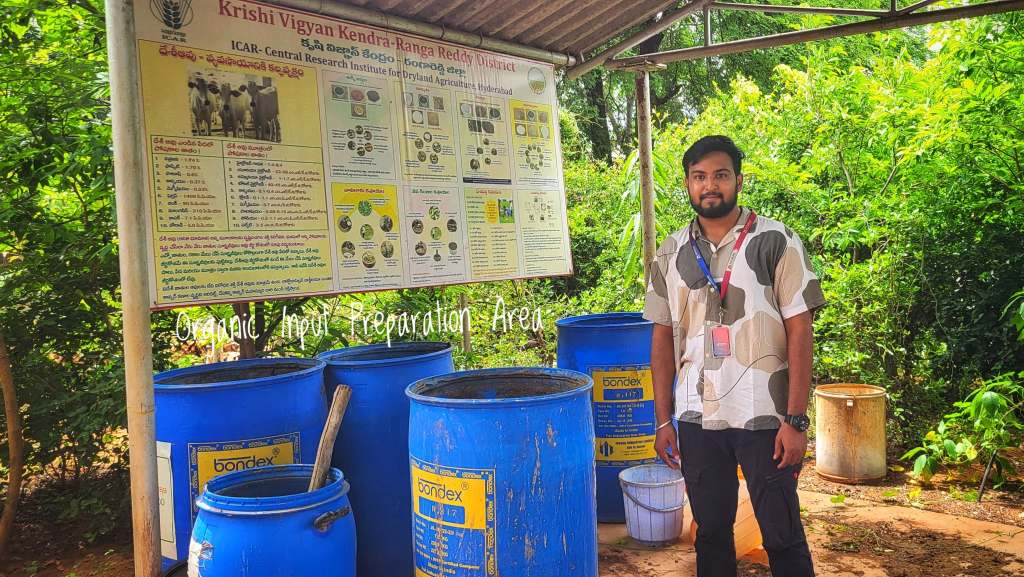
We then moved to the organic input preparation area, where they make liquid fertilizers using:
- Cow dung
- Cow urine
- Fermented plant extracts
And it wasn’t just one crop per plot. They practiced three-layer farming, maximizing space and resources. Oh and yes, they also had a few cows on-site, forming a complete cycle of nutrient recycling.
I loved how everything was connected:
Cows → Organic fertilizers → Soil → Crops → Nutrition → Farmers
No waste. No pollution. Just a full-circle system that respected nature.
From Cactus to Controlled Environment Farming A Glimpse of the Future
While walking between units, we came across thornless cactus and other dryland crops adapted to harsh conditions. But what really caught my eye was something unexpected:
A small prototype zone:
There it was a glimpse into the future of Indian farming:
- Vertical pillar structures
- Hydroponic setups
- White shade nets for controlled microclimates
My friend nudged me and said, “Look at that.”
And right then, a thought sparked in my head:
This is it. This is where agriculture is headed climate-smart, space-saving, and tech-driven.
It felt like we were seeing a seed of the next agricultural revolution… quietly growing in a corner of CRIDA.
What Stayed With Me After Visiting CRIDA
Good Seeds = Good Starts
One line stuck with me: “Good crops begin with good seeds.” CRIDA isn’t just storing seeds — they’re curating them. From breeder stock to gravity-based sorters to color-coded tags, it’s all about making sure that what goes into the ground has life in it.
Soil Is More Than Just Mud — It’s Alive
Watching organic fertilizers being brewed with cow dung and fermented plant juice reminded me of something basic we often forget: soil has a biology. And when we take care of it, it takes care of everything else the crops, the farmers, and the future.
Storing Rain Is Climate Adaptation 101
Nine lakh litres. That’s how much water one of their rainwater tanks holds. In a place where rain comes and goes like a guest, CRIDA is making sure not a drop is wasted. Water-smart farming is no longer optional it’s survival.
Nothing Is Wasted When Nature Leads the Design
Cows → Cow dung → Organic input → Crops → Farmers → Food. It was all there, cycling in harmony. Seeing it made me realize — true sustainability isn’t a trend or a product. It’s a loop — one that CRIDA is quietly perfecting.
Livestock Isn’t Just About Milk — It’s About Regeneration
I used to think fodder was just feed. But watching those blocks and understanding their role in restoring soil and supporting livelihoods made me realize — animals aren’t side players. They’re central to resilient farming ecosystems.
Hydroponics Isn’t Just a City Thing
Those vertical pillars under white shade nets? That’s not urban gardening aesthetics. That’s space-saving, resource-smart food production. And in places where land and water are limited, it could be the answer we’ve been ignoring.
