
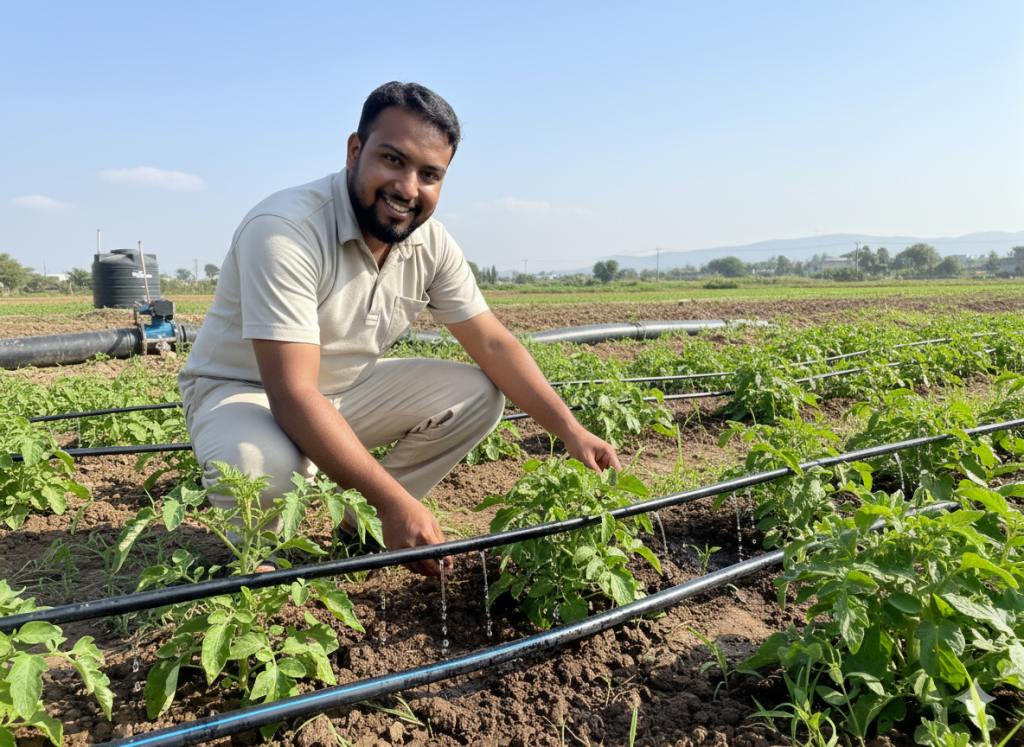
Ever noticed how a field can look drenched, yet the plants still thirst? Sunlight pulls water into the air, streams carry it away, and only a fraction reaches the roots. Imagine if every drop could travel straight to the spot where life begins the root itself.
The Origins of Drip Irrigation
The story begins in Israel, 1960s, when engineer Simcha Blass noticed a tree thriving beside a tiny leak in a pipe. Unlike the others, this tree grew greener because the slow drip fed its roots directly. That simple observation turned into the world’s first commercial drip irrigation system in 1964.
In a dry country where every drop mattered, this method was revolutionary. Instead of losing water to evaporation or runoff, drip lines delivered it straight to the root zone. The results were clear: 30–60% water savings and yields rising by 20–50%.
What began as a leak in a desert pipe became a global solution changing how we think about water, crops, and efficiency.
How Drip Irrigation Really Works
How Traditional Irrigation Wastes Water
For most of history, farmers relied on flood irrigation covering fields in water. But crops only use about 35–40% of it. The rest evaporates, seeps too deep, or runs off. Sprinklers improved efficiency to about 60–70%, but they still lose huge amounts to wind drift and uneven spread. Globally, this waste adds up: agriculture consumes 70% of all freshwater withdrawals, yet much of it never reaches a root.
The Precision of Drip Irrigation
Drip irrigation delivers water with almost surgical precision. Tubes and tiny emitters release it drop by drop at the root zone, raising efficiency to 90–95%. That means saving 30–60% water compared to flood methods. The payoff isn’t just in water yields rise by 20–50%, and fertilizer use drops by up to 40% thanks to fertigation (fertilizer dissolved in drip lines). In India, studies show sugarcane under drip uses 45% less water while increasing yields by 20%, and cotton farmers save 35–40% water with better fiber quality.
Best Fits and Limitations
Of course, drip isn’t universal. It shines in orchards, vineyards, vegetables, sugarcane, cotton, and flowers crops that benefit from steady, targeted moisture. That’s why states like Maharashtra and Karnataka have led adoption, using drip for grapes, pomegranate, banana, and even sugarcane.
But some cereal crops like rice and wheat still struggle under drip because they traditionally need standing water or uniform field moisture. For such staples, techniques like aerobic rice, sprinkler systems, or alternate wetting and drying are being explored instead. So while drip is powerful, it’s not a one-size-fits-all. The future likely lies in combining drip with other smart irrigation systems depending on the crop and region.
The Climate Connection
As droughts and erratic rainfall worsen, this efficiency becomes climate resilience. India alone has about 140 million hectares of net sown area, but less than 15% is under micro-irrigation (drip + sprinkler). Expanding drip even to half of irrigated land could save over 20–22 billion cubic meters of water annually roughly equal to the drinking water needs of the entire country for a year. Globally, if drip covered just 25% of irrigated land, it could feed an additional 500 million people while cutting irrigation-related energy use.
What It All Means
- Water savings: Drip irrigation reduces water use by 30–60% compared to flood irrigation.
- Higher yields: Crops grown under drip often see 20–50% yield increases.
- Nutrient efficiency: Fertigation through drip can cut fertilizer use by up to 40%, reducing costs and pollution.
- Climate resilience: Less pumping = lower energy demand and emissions, crucial in a warming world.
- Scalable solution: If India expanded drip to half its irrigated land, it could save 22 billion cubic meters of water annually.
The Thought That Lingers
Maybe the future of farming isn’t about adding more water, but about placing it wisely. A single drop, guided straight to the root, can grow food, save energy, and even soften the blows of climate change. Perhaps the real question is simple: if every drop matters, how will we choose to use ours?
