
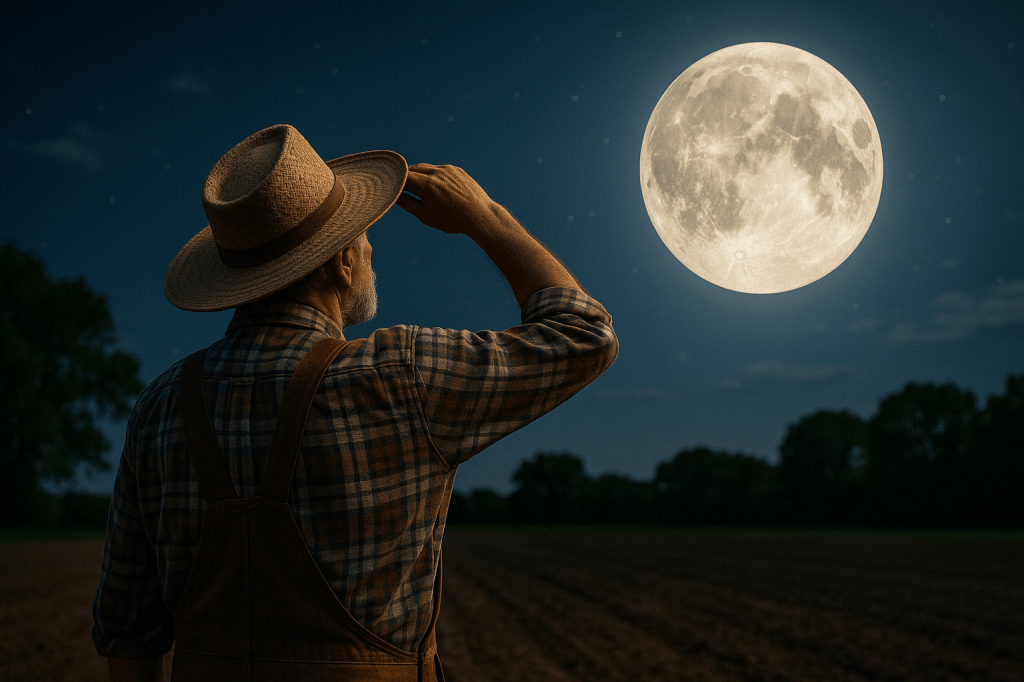
Somewhere between tradition and timing, there’s a quiet logic that’s been guiding farmers for centuries.
It’s not in a textbook or a soil lab report.
It’s written in the sky.
In villages across Indiaand across continents, from the Andes to Africa farmers look to the moon before they look to the seed bag. They wait for the right tithi, the right moonrise, or the perfect lunar phase to start sowing. And they don’t ask Google for a weather forecast. They ask the sky.
At first, I thought this was just cultural belief. Ritual. But then I started digging. And what I found is a rhythm a kind of ecological intelligence that’s easy to overlook if you’re only thinking in terms of NPK and calendar dates.
Let’s unpack the lunar logic.
The Moon and Soil Moisture: More Than Just Tides?
We all know the moon influences ocean tides. But here’s where it gets interesting: just like it pulls large bodies of water, some researchers believe the moon’s gravitational force may also affect moisture movement within the soil.
Here’s how that might work:
- During a new moon and a full moon, the gravitational pull is at its peak.
- This pull could theoretically draw water upward, increasing soil moisture near the surface.
- More moisture means better conditions for seed germination, especially in drylands or unirrigated farms.
This isn’t a proven law of physics in agriculture. But it’s also not a baseless myth. While large-scale studies are limited, the idea aligns with observable patterns in plant behavior. Some farmers even claim their seeds sprout faster or grow stronger when sown during specific moon phases.
Waxing, Waning, and the Crop Calendar
Lunar calendars don’t just stop at full moons. They divide the cycle into two key phases:
- Waxing phase (from new moon to full moon): Traditionally favored for sowing leafy crops like spinach, fenugreek, coriander, and even rice seedlings. The belief? As the moonlight grows, so does the energy directed above ground supporting stem and leaf development.
- Waning phase (from full moon to new moon): Considered ideal for root crops like carrots, potatoes, garlic, and turmeric. This phase is said to draw energy below the soil, encouraging deeper rooting.
Biodynamic farming which follows a more structured lunar-agriculture calendar goes even further. It outlines exact sowing, pruning, and harvesting dates tied to planetary movements and cosmic rhythms.
Even if you’re skeptical, one thing’s clear: many farmers swear by these cycles. And their commitment isn’t just cultural it’s observational.
India’s Moon Math: Panchang, Nakshatras, and Tithis
In India, moon-based farming has layers.
Many traditional farmers don’t just follow the basic waxing-waning principle. They consult the panchang a detailed lunar calendar that includes:
- Tithis (lunar days),
- Nakshatras (constellations),
- Yogas and Karanas (other astrological elements).
Certain tithis are seen as auspicious for sowing, while others are avoided. Some nakshatras like Rohini or Mrigashira are believed to bring timely rains or strong seedling vigor. These aren’t wild guesses; they’re patterns observed over generations.
What’s wild is how these align, sometimes eerily well, with optimal sowing windows suggested by modern crop calendars. Coincidence? Maybe. But maybe not.
What the Research Says (and What It Doesn’t)
Let’s be honest: the scientific community hasn’t spent much time validating lunar farming. Most agronomy research focuses on measurable factors like:
- Soil nutrients
- Irrigation schedules
- Weather data
- Seed genetics
That said, there are scattered studies showing small benefits:
- Some trials in biodynamic farms found improved germination rates when crops were sown during waxing moons.
- A few horticultural studies noted differences in pruning effectiveness based on lunar cycles.
Because what this shows is a gap between empirical science and ecological observation. Farmers aren’t always waiting for peer-reviewed papers they’re watching the skies, the soil, and the season. And that counts for something.
Superstition? Maybe. Strategy? Definitely.
Here’s the thing: whether or not the moon directly boosts yields, using it as a natural calendar helps farmers align with seasonal shifts.
Think about it:
- The moon is consistent and visible.
- Its phases act as easy-to-remember markers for planning.
- In rainfed farming especially, timing is everything. And the moon gives a rhythm that syncs farmers with nature not spreadsheets.
And sometimes, belief itself becomes a system. If a farmer trusts a date and sows with care, that focus and preparation can influence success too.
The Moon Is Not a Myth. It’s a Memory.
What I’ve come to realize is this:
Farming by the moon isn’t just about science.
It’s about synchrony with the soil, the seasons, the unseen forces that still shape the world around us.
We don’t need to romanticize everything. But we also shouldn’t dismiss practices that have survived for centuries.
Maybe the moon won’t magically triple your yield.
But it might remind you to pause, observe, and plant with intention.
And in today’s climate where every season feels unpredictable maybe that’s the kind of farming wisdom we need more of.
