
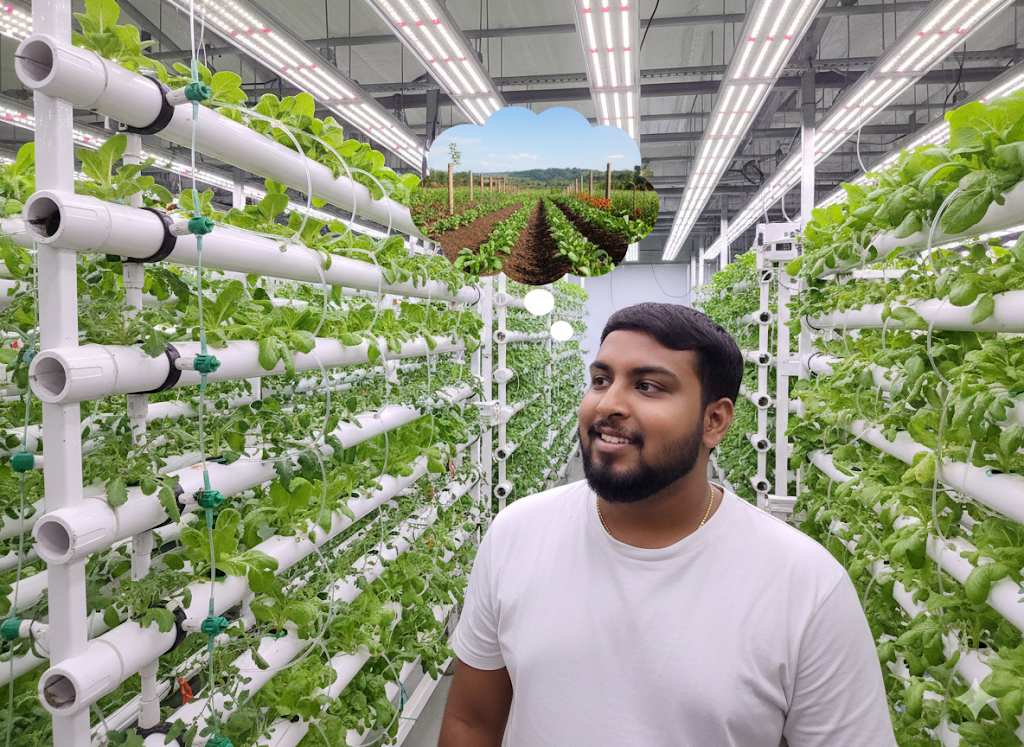
Until a few months ago, I believed soil was non-negotiable when it came to growing plants. No soil? No farming. Period.
Then one day, my maternal uncle sent me a reel. It showed rows of leafy greens lettuce, spinach thriving in a setup with no soil at all. Just water, pipes, and some high-tech looking trays. I watched it twice. I couldn’t believe it.
That was my first encounter with hydroponics. And honestly, it shook me.
I always thought soil was sacred the very foundation of agriculture. But the more I read about hydroponics, the more I realized: it’s not really the soil that plants need. It’s what the soil provides **nutrients, water, and a bit of support.
And guess what? Hydroponics delivers all of that sometimes even better. What Do Plants Really Need to Grow?
Once I stopped thinking of soil as the “soul” of farming, I asked myself a basic question: what do plants actually need to survive and grow?
Turns out, it’s just five things:
- Light – for photosynthesis. No light = no food for the plant.
- Water – to transport nutrients and maintain cell structure.
- Carbon dioxide (CO₂) – plants absorb it from the air to make glucose.
- Nutrients – minerals like nitrogen, phosphorus, potassium, calcium, magnesium, etc.
- Support – something to hold the plant upright as it grows.
That’s it.
Now here’s the twist: soil is just one way to provide some of these. It stores nutrients. It holds water. It anchors the roots. But if we can deliver all those essentials without soil—why not?
That’s where hydroponics comes in. It doesn’t eliminate the needs of the plant it just replaces the delivery system.
Instead of soil, plants grow in nutrient-rich water. Instead of roots stretching through mud, they float in oxygenated solution or sit in something like cocopeat or clay pellets. Every single requirement is still met.
So really, plants aren’t loyal to soil. They’re loyal to nutrients, water, light, and care.
How Hydroponics Works (Without Soil)
So if there’s no soil, how do hydroponic systems actually grow plants?
Here’s the short answer: they deliver nutrients directly to the roots through water.
But the real magic is in how precise and customizable the system is.
Nutrient Solution: Liquid Fertilizer, but Smarter
In hydroponics, plants are fed using a water-based solution that contains all essential nutrients like nitrogen, phosphorus, potassium, calcium, magnesium, and micronutrients.
Instead of waiting for roots to “find” food in soil, we give the plant exactly what it needs, when it needs it. You can even adjust the EC (electrical conductivity) and pH for optimal absorption.
Root Support: No Soil, No Problem
Plants still need something to hold them up. Materials like:
- Cocopeat
- Rockwool
- LECA (lightweight clay pebbles) provide support while allowing free flow of water and oxygen.
Oxygenation: Happy Roots Grow Better
In soil, roots can suffocate if the drainage is poor. But in hydroponics, air stones and pumps are used to oxygenate the solution, keeping roots healthy and stress-free.
Different System Types
From Deep Water Culture (DWC) to Nutrient Film Technique (NFT) and Drip Systems, hydroponics offers flexible setups for different crops, spaces, and budgets.
Bottom line? You’re not depending on the weather, the soil type, or rainfall. You’re farming with precision.
Hydroponics vs Soil: Who Wins the Growing Game?
So can hydroponics really compete with traditional farming?
In many ways, yes.
Water Efficiency
Hydroponics uses up to 90% less water than traditional methods, thanks to recirculation. In a water-stressed country like India, that’s huge.
Faster Growth
Plants often grow 20–50% faster in hydroponic setups, because they’re never nutrient-starved and the environment is fully optimized.
Fewer Pests and Diseases
No soil means fewer soil-borne diseases and less need for pesticides. The controlled environment keeps most pests in check.
Nutrient Control
You can tailor nutrient levels precisely for each crop and growth stage. In soil, much of this is guesswork.
Urban and Vertical Farming
Hydroponics allows food to be grown in cities on rooftops, balconies, and vertical racks closer to where people live.
And here’s an added bonus:
Hydroponics is the cheaper alternative to organic farming.
While organic systems require land, composting, and longer crop cycles, hydroponics can deliver high-quality, chemical-free produce with less space and fewer inputs.
That’s not just a win for farmers it’s a win for consumers, too.
But What About the Soil Microbiome?
This was my biggest concern.
We’re always taught that soil is alive full of beneficial microbes that help with nutrient cycling, disease resistance, and plant health. So what happens when we remove that ecosystem?
Well, in most hydroponic systems, the environment is sterile or semi-sterile by design. This reduces pests and pathogens but also limits microbial activity.
That’s not necessarily bad. Hydroponics isn’t trying to copy soil it’s replacing the need for it by delivering everything directly.
Still, some systems are now blending the best of both worlds. They’re adding beneficial bacteria, using aquaponics (where fish waste becomes fertilizer), or incorporating biostimulants to boost plant health.
It’s a reminder that hydroponics isn’t anti-microbe. It’s just more intentional about what goes into the system.
Why This Matters in a Warming World
Let’s face it climate change is already reshaping agriculture.
Rainfall is unpredictable. Soil is degrading. Groundwater is disappearing. Farmers are under pressure to grow more with less less land, less water, less stability.
Hydroponics can help us adapt.
- It uses less water.
- It doesn’t need fertile soil.
- It works in urban spaces.
- It produces food closer to where it’s consumed, reducing carbon footprints.
In fact, hydroponics could help take some pressure off our soil by allowing short-cycle crops to grow in controlled environments, while leaving more land available for long-cycle grains and regenerative practices.
It’s not about abandoning soil. It’s about sharing the load.
Closing Thoughts: Soil Isn’t the Enemy. But It’s Not the Only Way.
Let me be clear: I’m not anti-soil.
I admire what soil does for life on Earth from storing carbon to supporting biodiversity. And I truly believe we need more regenerative farming and organic practices that protect soil health.
But at the same time, hydroponics opened my eyes to what’s possible when we rethink the basics.
It’s not about replacing farmers. It’s not about replacing soil. It’s about expanding our toolkit to meet the demands of a changing planet.
So maybe the question isn’t “Which method is better?
Maybe it’s “Which method works best where, when, and for whom?
Because in the end, what matters is this: growing healthy, safe food sustainably, for a future that’s already arriving faster than we expected.
