
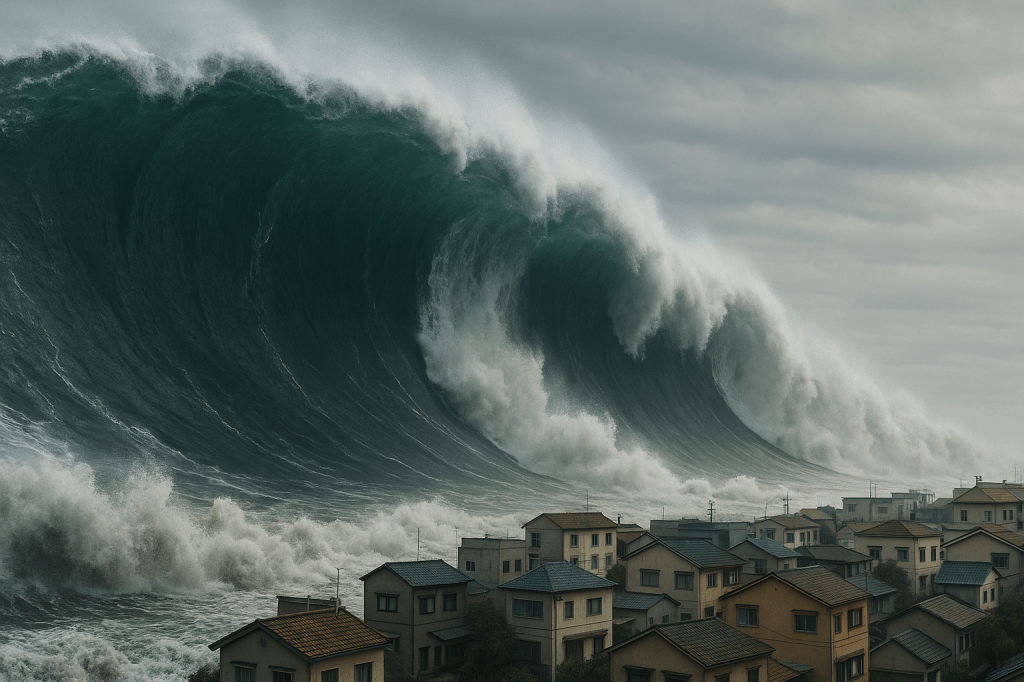
Lately, the internet’s been flooded with tsunami videos huge waves crashing into coastlines, people running, boats tossed around like toys. One clip after another kept popping up on my feed.
What really caught my eye though? A tweet from Donald Trump. He posted a warning about the tsunami and like him or not, that tweet got my attention. I hadn’t even heard there was a tsunami happening.
So I did what I always do when something feels off I started digging.
At first, I thought it was just another earthquake-triggered tsunami. But then I saw a video on YouTube that linked it to climate change. That surprised me. I always thought tsunamis were purely geological tectonic plates, earthquakes, deep-sea stuff. Not climate.
But apparently, there’s more to it. Sea level rise, warming oceans, coastal erosion all of it playing a silent but dangerous role in making tsunamis more destructive.
So I’m writing this blog to unpack it all how climate change might not cause tsunamis directly, but how it could be making them worse, especially in places like Japan and the U.S. Pacific coast.
Let’s get into it.
Tsunamis 101 – What Actually Causes Them
Before we connect anything to climate change, let’s first understand what causes tsunamis in the first place. Because here’s the thing tsunamis aren’t like cyclones or floods that come from weather. They’re usually triggered by something much deeper.
Literally.
Most tsunamis happen because of undersea earthquakes. When two tectonic plates suddenly shift, they displace a huge volume of water, and that creates those fast-moving waves. Think of it like dropping a rock in a still pond the ripples move outward. Now imagine that rock is a shifting fault line under the ocean floor.
Other triggers include underwater landslides, volcanic eruptions, or in rare cases, even a massive glacier chunk breaking off into the sea. But all of these are geological events not driven by atmospheric changes or greenhouse gases.
So on paper, climate change doesn’t directly cause tsunamis. No carbon emission can shift a tectonic plate.
But and this is where it gets interesting climate change is starting to mess with the conditions around tsunamis. Stuff like sea level rise, coastal erosion, and permafrost melt can all make the impacts worse when a tsunami hits.
And in some cases, it might even trigger the kind of underwater landslides that cause them.
That’s what we’ll unpack next. Because while the wave might come from the Earth’s crust, how far it travels and how much damage it does is definitely linked to what’s changing on the surface.
Where Climate Change Comes In
So, we’ve established that climate change doesn’t directly cause tsunamis. It’s not like rising temperatures make the Earth crack open. But here’s where it starts to matter the damage a tsunami does depends a lot on what it hits.
And that’s where climate change is silently raising the stakes.
Sea levels are rising. That means when a tsunami hits, the waves start from a higher base level. Even a few extra centimeters can mean the difference between flooding just a beach… or reaching deep into towns and villages. In low-lying coastal areas, this is a big deal.
Then there’s coastal erosion. Warming oceans and stronger storms are slowly eating away coastlines. Mangroves, sand dunes, and natural barriers that used to absorb wave energy? They’re vanishing. So when a tsunami arrives, there’s less to slow it down.
Glacial melt and permafrost thaw are another factor. In Arctic regions, melting frozen ground can trigger underwater landslides and those landslides can actually start a tsunami. It’s not common, but with global temperatures rising fast, scientists are keeping a close watch on areas like Alaska and Greenland.
There’s also thermal expansion. As oceans warm, water expands. It sounds minor, but it adds up not just in volume, but in instability. Warmer water behaves differently, and that can affect how energy moves through waves.
So even if climate change isn’t shaking tectonic plates, it’s changing the playing field. It’s making coastlines more fragile, water levels higher, and the margin of safety a lot thinner.
Japan and the U.S. West Coast Real-World Risks
When it comes to tsunamis, Japan is the first country that comes to mind. And for good reason it sits right along the “Ring of Fire,” where multiple tectonic plates meet. Earthquakes are frequent, and so are tsunami threats.
The 2011 Tohoku tsunami is still one of the most devastating disasters in recent history. A massive undersea earthquake triggered a wave over 10 meters high, hitting the Fukushima coast and causing a nuclear crisis on top of everything else.
But here’s something to think about: even though Japan has some of the best disaster-preparedness systems in the world, the rising sea level made the impact worse. Coastal defenses that were designed decades ago weren’t high enough anymore. And it’s only going to get more challenging.
Now let’s look across the Pacific the U.S. West Coast.
Places like California, Oregon, Washington they all sit near the Cascadia Subduction Zone, a fault line that could trigger a tsunami similar to Japan’s. Scientists have been warning for years that a “Big One” is overdue. And now, with rising sea levels and more people living near the coast, the potential damage has multiplied.
In both Japan and the U.S., it’s not just the earthquake we need to worry about. It’s the way climate change is quietly weakening our natural and built defenses raising the waterline, softening coastlines, and pushing the danger line further inland.
Even cities that were considered “safe” a few decades ago are now on the edge. Literally.
Final Reflection: It’s Not Just a Wave Anymore
When I first saw that tweet and clicked on a random tsunami video, I didn’t think it would lead me down this rabbit hole. I just wanted to know what happened. But the deeper I went, the more I realized we can’t look at natural disasters the same way anymore.
Tsunamis used to be a geology topic. Earthquakes, tectonic shifts, deep-ocean stuff. Now, climate change is part of that conversation too. Not because it’s causing the earthquakes, but because it’s changing the world those earthquakes strike.
Higher seas. Weaker coasts. Bigger risks.
It’s easy to think of a tsunami as just one big wave. But it’s really a chain reaction and climate change is quietly adding fuel to that chain. The scary part? The wave isn’t getting taller. The land is just getting more vulnerable.
If there’s one thing I’ve learned while writing this, it’s this: we need to stop treating disasters like they exist in isolation. Tsunamis, floods, droughts they’re all connected. And they’re all being shaped, amplified, or worsened by the climate crisis.
So the next time we see another viral clip or breaking headline, maybe we dig a little deeper. Ask a few more questions. Because sometimes the real story isn’t in the wave.
It’s in everything that made us less ready for it.
