
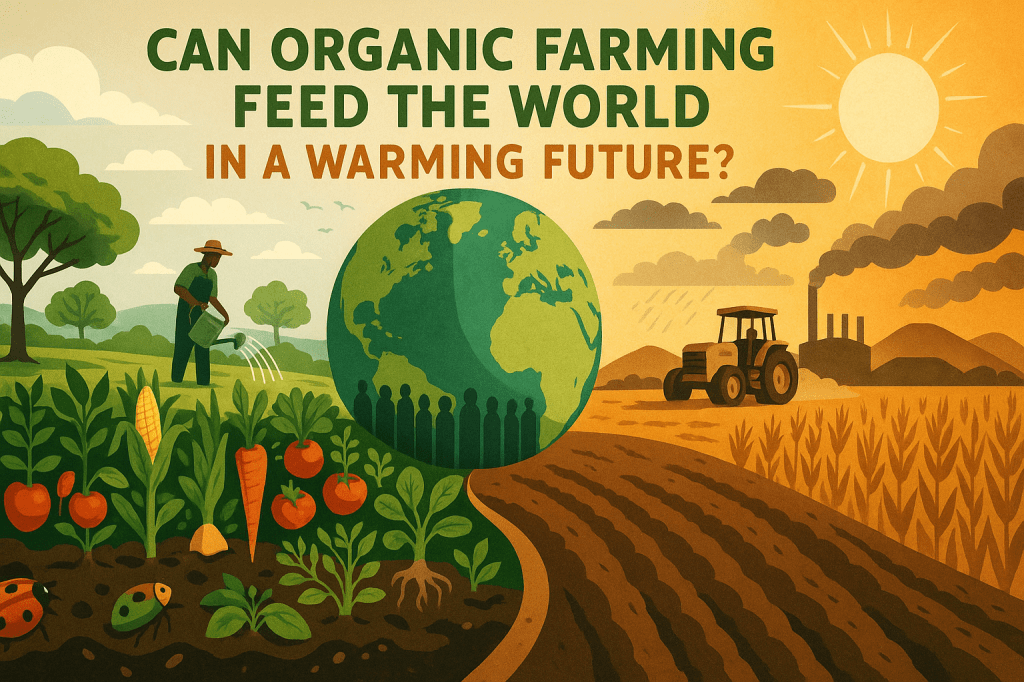
One question that’s been quietly sitting in the back of my mind, popping up during lectures, field visits, even while eating lunch…
Can organic farming really feed the world in a warming future?
It’s not just an academic thought. Every time I hear someone say “organic is the future” or see big, bold labels in grocery stores, I wonder how practical is this? With climate change reshaping agriculture, can a system that avoids synthetic fertilizers and pesticides actually keep up with the growing demand for food?
Let’s dig into this from both the heart and the soil.
The Climate Crisis Is Already on Our Plates
We’re heading towards a population of 10 billion by 2050. Meanwhile, climate change is throwing curveballs at agriculture every season:
- Unpredictable monsoons
- Prolonged droughts
- Heatwaves during flowering stages
- Sudden pest outbreaks
In my agri classes, we’re constantly shown maps of shifting agro-climatic zones. What used to grow well in one region is now struggling. Yields are dipping. And the pressure to “produce more, faster” is mounting.
Conventional farming does get result but often at an environmental cost. So that brings us back to the question:
Could organic farming be the climate-resilient answer we need?
What Does Organic Really Mean? (Beyond the Sticker Label)
When we say “organic,” what are we actually talking about?
At its core, organic farming is about working with nature, not against it.
That means:
- No synthetic fertilizers or pesticides
- No genetically modified crops
- Crop rotations, green manures, compost, and biofertilizers
- Emphasis on soil health, biodiversity, and ecological balance
Sounds great, right? But here’s the thing “organic” doesn’t always mean “perfect.” Certification standards differ. Some organic systems are deeply rooted in traditional, regenerative practices. Others? Just industrial-scale farms swapping chemicals for allowed natural inputs.
So the real question is which version of organic are we evaluating when we ask if it can feed the world?
Organic Farming in Droughts: A Quiet Resilience
Let me take you back to a moment from one of our practicals last year.
We were standing in two adjacent plots one conventionally managed with chemical fertilizers, the other using organic compost and cover crops. The season had been brutal. Rainfall came late, then disappeared for weeks. We expected both plots to struggle. But surprisingly, the organic one held on better. The plants were wilted, yes, but not scorched. The soil under our boots was still moist.
That’s when our professor said something that stuck with me:
“Soil is like a sponge and organic matter is its best friend.”
Turns out, healthy soil rich in carbon, microbes, and organic matter retains more water, even during dry spells. It’s also better at absorbing heavy rain without turning into a flood zone.
Multiple studies back this up. The Rodale Institute’s long-term trials in the U.S. found that organic systems can outperform conventional ones in drought years. Why? Because they build the soil instead of mining it.
So while organic farming might not promise record-shattering yields every year, it offers something else: stability and in a climate-challenged world, that’s gold.
The Yield Debate: Can Less Ever Be More?
Now let’s be honest this is where organic farming gets hit the hardest.
According to many meta-analyses, organic yields are on average 20–25% lower than conventional systems. Especially for high-input crops like wheat, rice, and maize. And in regions with poor soils or limited access to organic inputs, that gap can widen.
Critics say this means organic farming isn’t scalable. That if we go fully organic, we’ll need more land, which could lead to deforestation and biodiversity loss the exact opposite of what we want.
But hold on.
What if “yield per hectare” isn’t the only metric that matters?
What about:
- Nutritional value per acre?
- Carbon stored in soil per hectare?
- Pesticide load reduced per kg of food?
- Jobs created per farm?
And let’s not forget one-third of all food produced globally is wasted. Fixing that alone could feed billions.
So maybe the question isn’t “Can organic farming match conventional yields?”
Maybe it’s: “Can we rethink what success looks like in farming?”
The Middle Path: Regenerative, Blended, Smart
This is where things get exciting.
Across India and the world, farmers, scientists, and startups are building bridges blending organic wisdom with modern innovation.
Take Andhra Pradesh’s Community Managed Natural Farming (CMNF) movement. Over 700,000 farmers have adopted practices like:
- Jeevamrutham (fermented microbial tonic)
- Mulching and intercropping
- No synthetic inputs
And early reports show increased soil fertility, reduced pest attacks, and steady yields all while lowering input costs.
Then there’s the idea of regenerative agriculture which isn’t limited to certified organic, but focuses on outcomes like soil carbon, biodiversity, and ecosystem restoration.
Even some tech-driven models are pitching in.
Precision ag + compost = better nutrient targeting.
Biofertilizers + drone spraying = reduced emissions.
We don’t need to choose one path. We can blend them.
What I Believe And What I’m Still Figuring Out
As a student of agriculture, I’ve gone back and forth on this.
Then I visit a thriving, zero-budget natural farm and think, This is the future.
So here’s where I’ve landed for now:
- Organic farming alone may not feed the world at least not the way we currently eat, waste, and distribute food.
- But organic principles are essential to survive in a warming future: building soil, reducing chemical dependence, respecting biodiversity.
- The way forward isn’t black or white. It’s mosaic agriculture context-specific, inclusive, and climate-smart.
So… Can Organic Farming Feed the World?
Maybe not by itself.
But maybe that was never the real question.
The real questions are:
- Can we reduce food waste and rethink consumption?
- Can we support smallholders to adopt low-cost, regenerative methods?
- Can we redesign food systems for nutrition and resilience, not just yield?
And in answering those organic farming has a massive role to play.
