
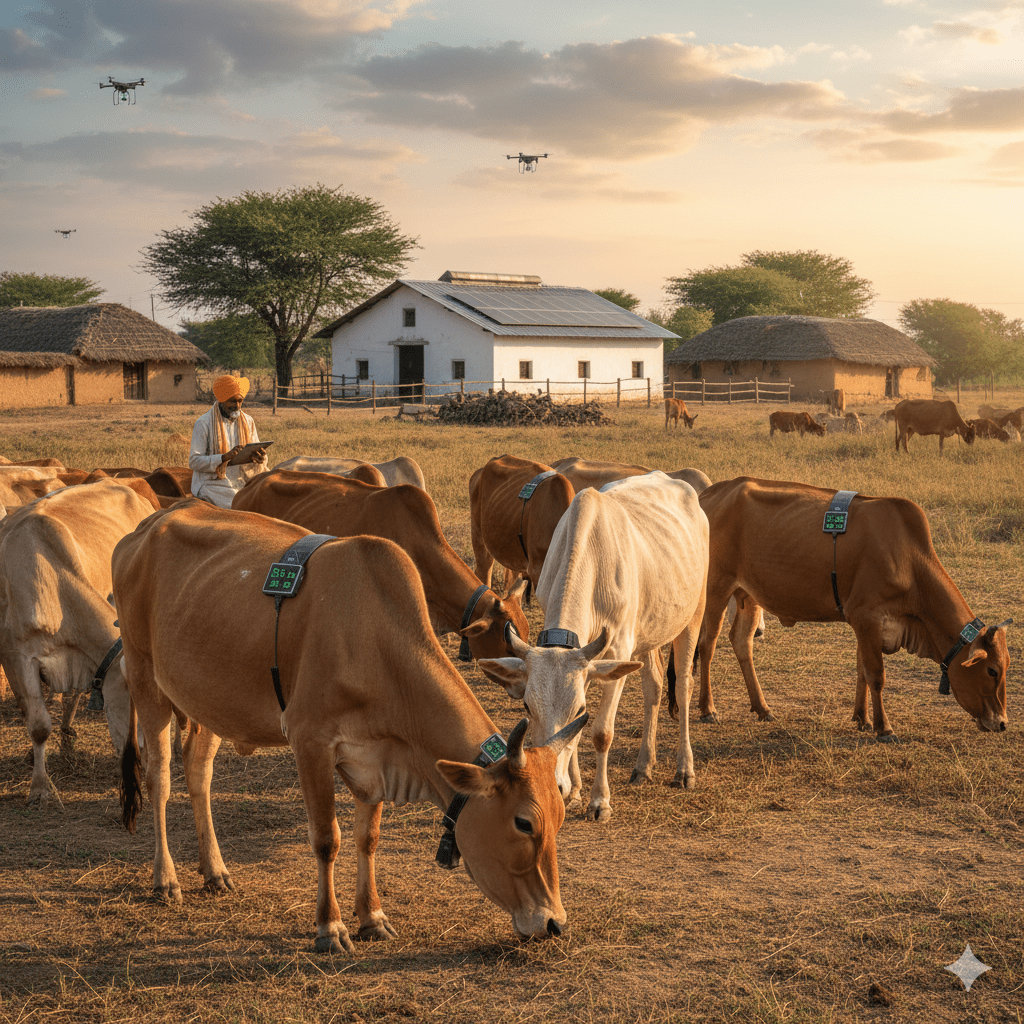
In India, we often talk about coal and cars when it comes to climate change. But as I discovered in my agriculture lectures, the real Emissions source might just be standing in our fields: cows and buffaloes. These animals produce methane a greenhouse gas far more potent than carbon dioxide and their burps and farts are quietly heating up our planet.
Methane: A Potent Greenhouse Gas
Methane (CH₄) is more than 25 times stronger than carbon dioxide (CO₂) at trapping heat over a 100-year period. It makes up a smaller share of total emissions, but its impact is disproportionately heavy. Because methane is so powerful, even small reductions can deliver a big climate win.
How Livestock Produce Methane
Cows and buffaloes are ruminants, meaning they digest food with the help of microbes in a specialized stomach chamber called the rumen. This process enteric fermentation breaks down plant material but also produces methane as a byproduct. Most of this methane escapes through burps, with a smaller fraction released as flatulence.
Global Emissions from Livestock
According to the FAO, livestock is responsible for about 14.5% of global greenhouse gas emissions, with enteric fermentation making up nearly 40% of that share. One cow can release 70 to 120 kg of methane each year. Multiply that by over 1.7 billion cattle and buffaloes worldwide, and you see why this is a climate problem we can’t ignore. In 2018 alone, the livestock sector emitted an estimated 2.1 gigatons of CO₂-equivalent methane.
The Climate Impact
Methane’s global warming potential is high, but its atmospheric lifespan is relatively short about 12 years. This means cutting methane today could cool the planet faster than CO₂ reductions alone. In a time of record-breaking heatwaves and unpredictable monsoons, livestock methane is a lever India and the world can’t afford to overlook.
India, with the world’s largest cattle and buffalo population (over 300 million), is also the largest milk producer which makes livestock methane both a challenge and an opportunity.
Mitigation Strategies
The good news? We already know ways to cut livestock methane without harming productivity.
- Dietary Adjustments: Adding fats, oils, or specific feed additives can suppress methane production in the rumen.
- Selective Breeding: Breeding animals that are more feed-efficient and naturally produce less methane.
- Better Manure Management: Composting and biogas digesters can capture methane before it escapes.
- Grazing Practices: Rotational grazing improves soil health and helps sequester carbon.
- Innovative Technologies: Researchers are developing methane inhibitors, vaccines, and engineered microbes for the future.
For India’s dairy farmers, these solutions aren’t just about emissions. Improved feed means healthier cattle and better milk yields. Biogas plants can turn manure into clean cooking fuel or electricity, offering extra income while cutting methane. Climate-smart livestock, if done right, can be a win-win for farmers and the planet.
Conclusion
Cows and buffaloes are part of India’s cultural fabric and daily nutrition. But their methane emissions are a climate challenge we can’t ignore. In a country where milk is poured into every cup of chai, the methane question isn’t just about emissions it’s about livelihoods.
So here’s the big question: can India lead the way in making livestock climate-smart while protecting farmers?
