
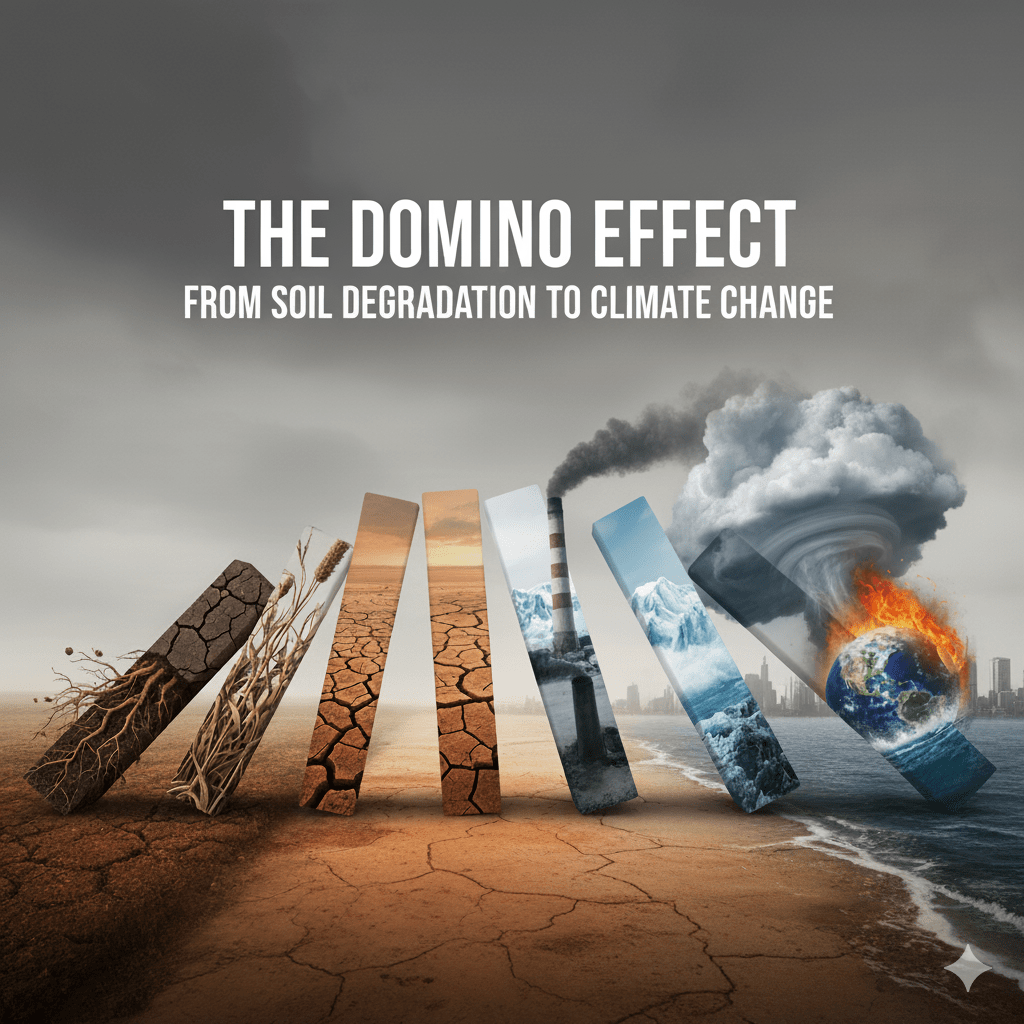
Soil isn’t just dirt under our feet it’s a living system. It stores water, supports crops, and provides a home for billions of microbes. At its heart is Soil Organic Carbon (SOC), formed from decomposed plant and animal matter. SOC is what gives soil fertility, resilience, and structure. Just as importantly, it acts as a carbon sink, locking away CO₂ that would otherwise fuel climate change.
How Intensive Farming Breaks Soil
Modern farming has boosted yields but often at the cost of long-term soil health.
- Monoculture: Planting the same crop repeatedly drains nutrients and organic matter. Soil becomes weak, biodiversity disappears, and erosion accelerates.
- Excessive Tillage: Frequent plowing breaks soil structure and kills microbes. Exposed soil is then carried away by wind and water, stripping it of its carbon-rich top layer.
When soils degrade, their carbon-holding power collapses. Instead of absorbing CO₂, they release it back into the air. Soil stores nearly three times more carbon than the atmosphere but only if we protect it.
The Vicious Cycle of Soil and Climate
- Soil organic matter is lost.
- Stored carbon is released as CO₂.
- Greenhouse gases rise, worsening climate change.
- Hotter, drier, and more extreme weather further damages soils.
This cycle doesn’t just weaken the ground beneath us it destabilizes food systems and accelerates global warming.
India’s Soil Reality
The problem is not abstract for India. According to the FAO, nearly 30% of India’s land is already degraded. Regions like Bundelkhand suffer severe erosion, while Punjab’s fertile soils are depleting from intensive paddy–wheat cycles.
The government has recognized this. Through the ICAR Soil Health Card program, over 220 million farmers have received data on their soil’s nutrient status, helping them use inputs more efficiently. But reports still show that farmers often lack access to organic matter or sustainable practices to rebuild their soils.
The Consequences of Soil Erosion
Soil loss doesn’t end at the farm boundary.
- Rivers get clogged with sediments, harming aquatic life.
- Topsoil vanishes, slashing crop yields.
- Farmers spend more on fertilizers to compensate, pushing them into debt.
- Food security suffers as productivity falls.
What Can Turn the Tide?
The solutions are known they just need scaling up:
- Cover Crops: Legumes and grasses protect soil between seasons, adding fertility.
- No-Till Farming: Keeps carbon locked in, while protecting microbes and soil structure.
- Crop Rotation: Breaks pest cycles, improves biodiversity, and restores nutrients.
- Agroforestry: Trees on farms reduce erosion, retain water, and add income streams.
These practices don’t just save soil they strengthen food security and act as climate solutions.
Conclusion: A Call to Act on Soil
Soil degradation is a silent crisis, eating away at our ability to farm, feed, and fight climate change. But if India can prioritize soil health through programs like Soil Health Cards, farmer training, and sustainable practices the story can change.
Soil, water, and seeds may be farming’s foundation. But without healthy soil, the entire house of agriculture crumbles.
Should soil health be placed at the center of India’s climate action, alongside energy and water?
