
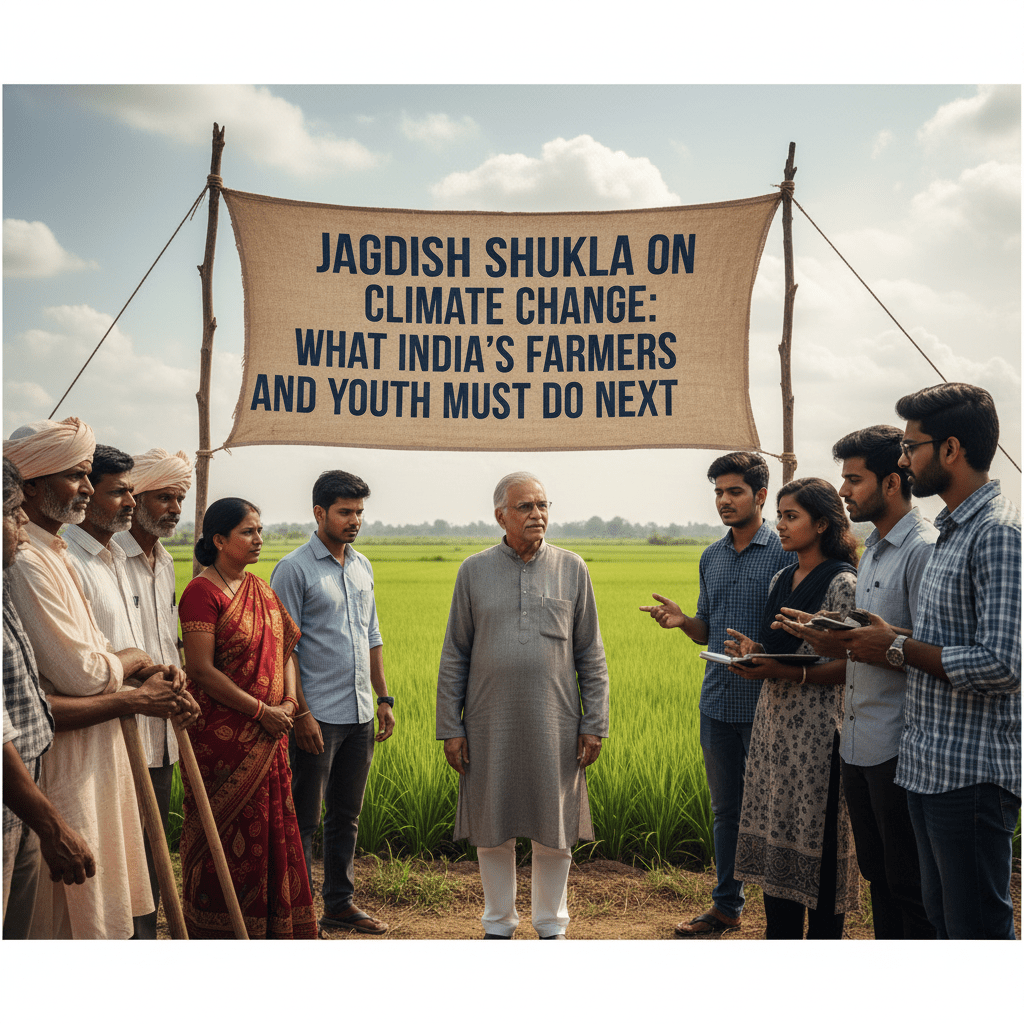
I was on my college bus, headphones in, listening to Ranveer Allahbadia’s podcast. Others scrolled Instagram reels, but I tuned into a conversation with climate scientist Jagdish Shukla. His words hit differently. They weren’t abstract predictions they were warnings that connect directly to the future of farming, food, and the communities we belong to.
The Urgency of Shukla’s Warning
Shukla didn’t sugarcoat the next 10–20 years: rising seas, extreme weather, and continued coal dependence will rewrite how we live. Cities like Mumbai, Kolkata, and Chennai could face submergence if we fail to act.
At the same time, he praised renewable energy initiatives, especially Prime Minister Modi’s push for solar, as a step in the right direction. Energy choices, he argued, aren’t just about electricity they’re about survival.
Agriculture: The Silent Frontline
While Shukla spoke largely about coal and energy, the ripple effects land hardest on farmers. Extreme heatwaves are already cutting wheat yields in India by 10–15% in peak years. Rising seas threaten rice-growing deltas in Bengal. Shifting rainfall patterns leave millions of small farmers uncertain about sowing seasons. When wheat yields fall 10–15%, it’s not just farmers who suffer food prices rise, hitting middle- and lower-middle-class families hardest.
Renewable energy isn’t only about clean skies it’s about protecting crops, ensuring food supply, and securing farmer livelihoods in a climate that’s becoming hostile.
The Role of Science and Policy
Shukla’s career is proof that science matters. He helped build India’s weather forecasting systems, established the Ministry of Earth Sciences, and pushed for climate commitments at forums like the Paris Conference.
But science alone isn’t enough. Policy must follow. That means moving away from coal, scaling up solar, and crucially linking clean energy with climate-resilient farming practices like irrigation efficiency, drought-proof seeds, and soil restoration.
Youth and Climate Anxiety
Shukla acknowledged what many of us feel: climate anxiety. As students, we scroll headlines of floods in Assam, heatwaves in Delhi, farmer protests across states and it’s overwhelming.
But he reminded us that anxiety without action solves nothing. For me, that means research in climate-smart farming. For others, it could mean supporting solar adoption in villages, joining community-led sustainability projects, or advocating for farmer-first policies. The point is simple: youth aren’t bystanders we’re participants in shaping resilience.
Challenges and Solutions We Can’t Ignore
Coal-fired power plants remain one of the biggest emitters, choking both air quality and climate stability. Transitioning away is urgent.
Solutions exist:
- Electric vehicles to clean up transport.
- Solar and wind power to replace dirty coal.
- Better home insulation to cut energy demand.
- Climate-resilient agriculture to reduce farm losses.
Every ton of emissions avoided protects not just air but crops, water, and farmer incomes.
Actionable Insights
- Adopt Renewable Energy: Solar panels, EVs, and decentralized clean energy.
- Reduce Personal Consumption: Save energy, minimize waste, choose sustainable products.
- Educate and Advocate: Spread climate awareness, push for farmer-focused climate policies.
- Support Research: Encourage innovations in climate-resilient agriculture.
- Community Involvement: Join or start local projects that cut emissions and help farmers adapt.
A Final Reflection
Shukla’s message was clear: climate change isn’t far away, it’s here. And while global leaders negotiate emissions cuts, farmers, students, and communities are already living the consequences.
So here’s the real question: should India’s climate strategy balance clean energy with resilient farming? And how can young people like us help drive that balance?
