
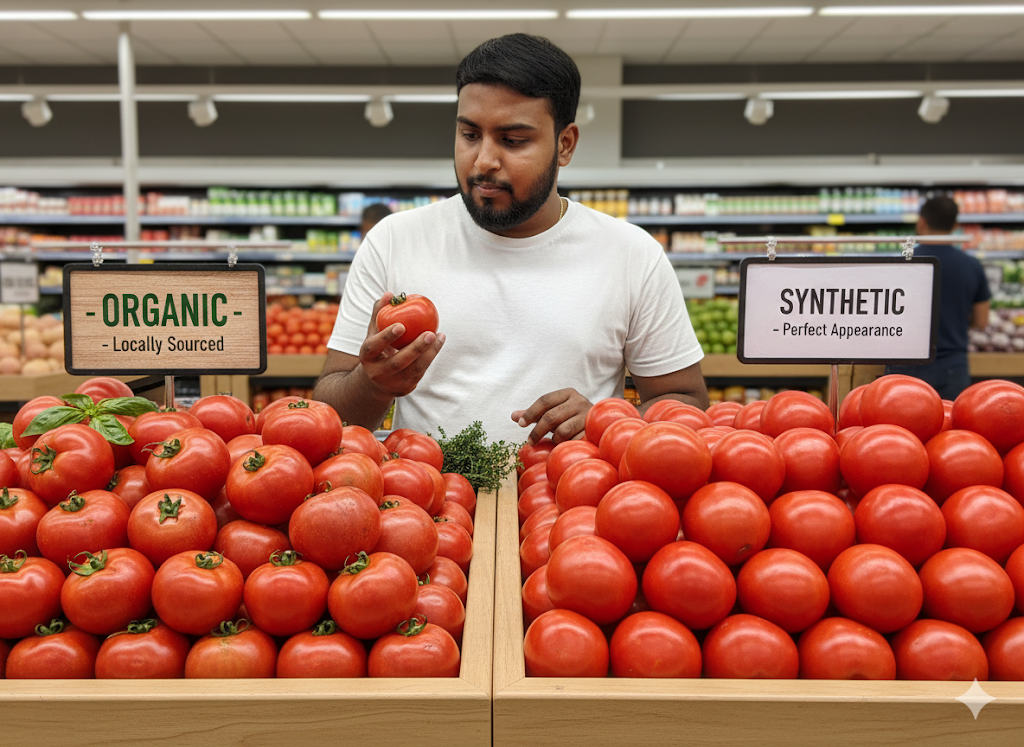
I was 19 when mum sent me to buy 1 kg of tomatoes. Simple task, nothing big. Back then, I already “knew” organic food was better chemical-free, healthier, kinder to the soil. But honestly? I didn’t really understand what that meant beyond a few textbook lines.
At the store, I stood staring at two baskets. Organic tomatoes were smaller, duller, and cost more. The synthetic ones? Shiny, uniform, bright red and almost double the quantity for the same price.
I picked the synthetic ones without thinking too much. It just felt like the smarter deal. But walking back that day, one question stuck: if organic food is better for us and the planet, why do we still choose synthetic so easily?
Why Synthetic Produce Wins So Easily
Synthetic produce looks like it’s been photoshopped before reaching the shelf. Bright colors, perfect shapes, no blemishes at all. Our brains instantly connect that look with quality.
Then comes the price. Farmers using chemicals grow more, faster, and lose less to pests. That means cheaper produce for both sellers and buyers. When you’re planning monthly groceries, price almost always beats purity.
And don’t forget convenience. Synthetic fruits and vegetables are everywhere, every day. Organic is seasonal, limited, and often tucked away in specialty stores.
So in the real world tight schedules, tight budgets, and a love for perfection synthetic becomes the default choice.
The Price Barrier: My First Realization
Even after I learned more, the same doubt kept bothering me: Why is organic food always more expensive?
I finally asked a friend in my BSc Agriculture course whose family farms in Andhra Pradesh. His answer changed the way I looked at it.
He told me that to call land “organic,” farmers must avoid chemicals for at least three years. Three years! No fertilizers, no pesticides. Sometimes they even leave fields fallow meaning no crop and no income. Even after conversion, crops grow slower because natural fertilizers release nutrients gradually, unlike the quick boost from synthetics.
Organic farming, I realized, isn’t just about food. It’s about patience, sacrifice, and surviving those tough in-between years.
The Struggles Farmers Face
Inputs are another challenge. Organic farming relies on cow dung, urine, neem cake, bone meal, green manure, and vermicompost. All harder to source and more labor-intensive than a cheap bag of urea.
And after all that effort, yields are often lower. Meanwhile, the neighbor using chemicals gets more with less struggle. To survive, the organic farmer has no choice but to sell at higher prices.
Then there’s the confusion in markets. Unlike packaged foods with “organic” stickers, loose vegetables don’t carry proof. Many people simply guess based on shelf life if it spoils quickly, it must be organic. But that doesn’t build trust.
And finally, awareness. A lot of consumers still think chemicals harm only the soil, not the food on their plates. When price is the only filter, nutrition and soil health fade into the background.
Why It All Matters
This isn’t just about which tomato ends up in your curry. It’s about soil health, farmers’ lives, and even the climate.
Heavy use of fertilizers and pesticides might look good in the short term, but residues linger on food and seep into water. Farm workers and nearby communities face the brunt. And soils? They slowly lose life. I’ve seen it during field visits land turning hard and lifeless after years of chemical use.
There’s also the climate angle. Nitrogen fertilizers release nitrous oxide, a greenhouse gas nearly 300 times more powerful than CO₂. So conventional farming isn’t just a soil issue. It’s a climate issue too.
The Hope: Regenerative Practices
What gives me hope is regenerative agriculture. It’s not only about avoiding chemicals, but actively healing the land. Practices like crop rotation, cover crops, green manures, and biofertilizers restore fertility, improve biodiversity, and even lock carbon back into the soil.
Farming doesn’t have to be destructive it can be part of the solution. But for that, farmers need support, fair pricing, and most importantly, our demand.
The Solution Starts with Us
Right now, organic produce is costly mainly because demand is low. Few farmers grow it, supply stays small, and prices stay high.
But here’s the cycle: if more people start buying, even a little, demand rises → more farmers switch → supply grows → prices come down.
It doesn’t happen overnight. But every conscious choice adds up. Every time we pick organic, we’re investing in a healthier food system for ourselves, for farmers, and for the planet.
Closing Thoughts
At 19, I picked synthetic tomatoes because they looked better and cost less. Today, I know that choice was more than just about tomatoes it was about farmers, soil, and the future of food.
Organic farming may look small, but it connects health, environment, and livelihoods in one chain. Every time we choose organic, we’re choosing a better system.
We don’t need to be perfect. Just aware. And willing to care one vegetable at a time.
