
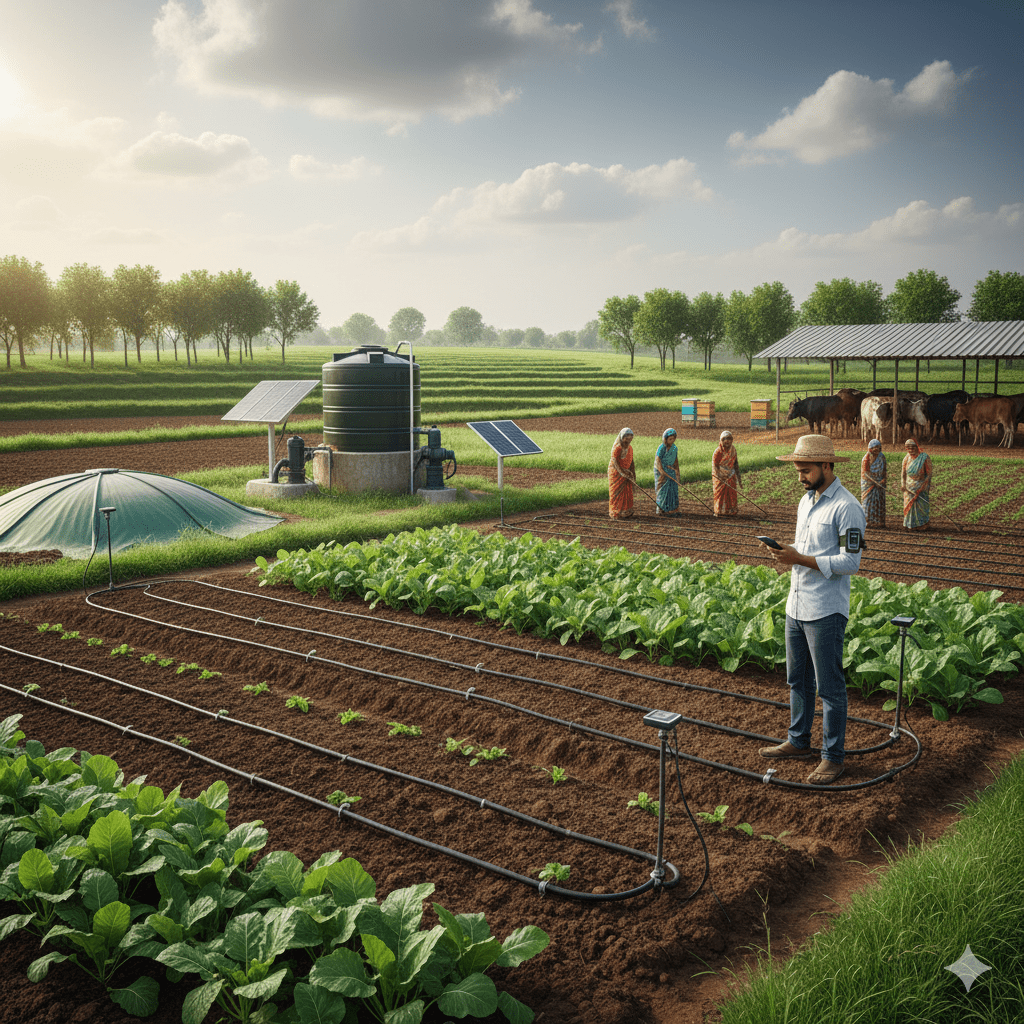
I still remember sitting in class on a hot May afternoon when our professor said, “Farmers are no longer just food growers, they are frontline climate fighters.” That line stuck with me. Because if you talk to farmers in Telangana today, you’ll hear the same worry: the monsoon comes late, paddy fields dry out, and pests attack earlier. To cope, many have begun mixing paddy with pulses so that even if rains are delayed, at least one crop survives. That’s climate resilience in action and it’s becoming essential across India.
Why Farmers Must Adapt Now
Climate change is hitting farming on multiple fronts: unpredictable rains, prolonged droughts, heat stress, and pest outbreaks. In 2023, for example, heatwaves cut wheat yields in North India by nearly 15%, while erratic rains delayed paddy sowing in eastern states. These shocks directly reduce yields, shrink incomes, and threaten food security. Adaptation strategies give farmers tools to cope by making agriculture more flexible, efficient, and climate-ready.
Key Adaptation Strategies for Climate-Resilient Agriculture
1. Crop Diversification: Spreading the Risk
- What It Is: Growing multiple crops instead of betting everything on one.
- Why It Helps: If drought hits paddy, pulses may still thrive. If pests damage cotton, millets stand strong. Diversity also boosts soil health and reduces erosion.
- Examples: Telangana farmers mixing rice with pulses; African farmers planting beans, maize, and root crops together. Diversity becomes a safety net.
2. Drought-Resistant Crops: Farming with Less Water
- What It Is: Varieties bred to withstand low rainfall and high heat.
- Why It Helps: They need less irrigation, save water, and hold yields steady in dry years.
- Examples: Sorghum and millets in India; drought-tolerant maize in East Africa; ICAR’s heat-resistant wheat offering security against temperature spikes.
3. Agroforestry: Mixing Trees with Crops
- What It Is: Growing trees alongside traditional crops.
- Why It Helps: Trees act as windbreakers, keep soil moist, recycle nutrients, and add income through timber, fruit, and fodder. They also sequester carbon, tackling climate change directly.
- Examples: In Kenya, farmers plant nitrogen-fixing Faidherbia albida with maize. In Tamil Nadu, coconut, mango, and pepper are grown together in traditional agroforestry systems.
Supporting Tools That Strengthen Resilience
- Conservation Agriculture: Minimal tillage, cover crops, and crop rotation to keep soil fertile and moist.
- Climate-Smart Irrigation: Drip and sprinkler systems, paired with rainwater harvesting, to maximize water efficiency.
- Early Warning Systems: Mobile-based weather forecasts guiding farmers on sowing, irrigation, and pest management.
Barriers Farmers Face
- Costs: Many smallholders cannot afford new seeds, irrigation, or equipment without financial support.
- Knowledge Gaps: Training and awareness are crucial resilience only works if farmers know how to implement it.
- Policy Support: Subsidies, crop insurance, and extension services are key to scaling adaptation practices.
The Role of Policy and Community Support
Governments must provide the push: subsidies for climate-smart seeds, incentives for drip irrigation, and funding for agroforestry. Community groups and NGOs can amplify this by training farmers, pooling resources, and helping smallholders adopt sustainable methods affordably.
Conclusion: Building a Future-Ready Agriculture
Farmers are not just adapting they’re innovating. From millets in Rajasthan to paddy–pulse systems in Telangana, climate-resilient practices are already reshaping India’s fields. These strategies not only protect farmer incomes but also strengthen food security for the nation.
Soil, water, and crops form the foundation but without the roof of climate resilience, the house of farming cannot stand. The question is: will we strengthen that roof now, or wait until the storm tears it apart?
