
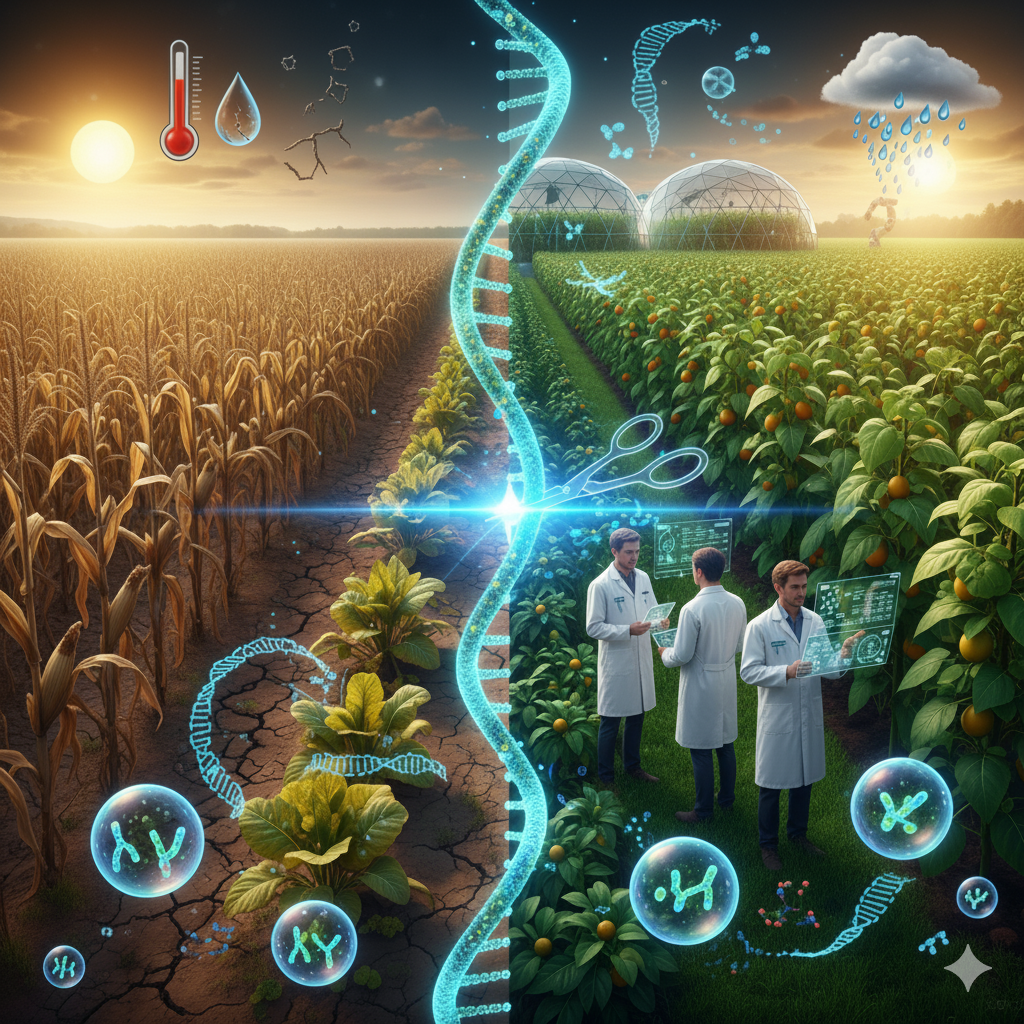
Farming today feels less predictable than the weather forecast and the forecast itself is getting worse.
But what if crops themselves could adapt rewritten to handle stress like pros? That’s where CRISPR comes in, the gene-editing tool quietly reshaping the future of food.
My First Spark With CRISPR
I still remember my professor saying, “CRISPR is like cut-paste on a Word document, but for DNA.” That line stopped me in my tracks. Farming, in my mind, was always soil, water, and sunlight. Suddenly, I realized it could also be about rewriting life’s code itself.
That moment planted a thought: if this tool works for crops, maybe it’s our best shot at farming in a climate that refuses to play fair.
CRISPR 101: The DNA Toolkit
Imagine giving plants a personal editor. CRISPR-Cas9 is just that.
GPS for DNA
A guide RNA acts like Google Maps, taking Cas9 scissors to the exact DNA spot.
Snip and Repair
Cas9 makes the cut, and the plant’s repair system either disables a faulty gene or installs a useful tweak.
Beyond Cutting
Scientists even use dCas9, a “dead” version that doesn’t cut but works like a dimmer switch turning genes on, off, or glowing for study. Think of it as farming with surgical precision.
Why Crops Need This Genetic Armor
Climate stress is brutal: drought dries leaves, heat fries pollen, salinity poisons roots. CRISPR offers plants a way to fight back.
Take drought. Plants naturally release ABA, a hormone that closes leaf pores to save water. By tweaking ABA-related genes like AREB1 and bZIPs, scientists boost this survival mode. In rice, switching off “troublemaker” genes like OsDST made plants survive better under stress. It’s like debugging crop software.
And the wins are real:
Kamala rice (India): Developed with CRISPR tweaks, it yields 20–30% more in dry soils while maturing faster helping farmers avoid late-season droughts. ARGOS8 maize (US trials): Edited to regulate stress genes, it produced higher grain yields under drought with no penalty in normal seasons. Tomatoes (China & Japan): CRISPR-edited plants showed better drought tolerance after NPR1 knockouts, surprising researchers who first studied it for disease resistance.
These aren’t lab fantasies. They’re field-tested signs that crops can be tougher without sacrificing taste, yield, or quality.
The Climate Connection We Can’t Ignore
Here’s where it all clicks: climate change is rewriting farming faster than farmers can adapt. NASA reports 2023 as the hottest year on record, with global surface temperatures 1.35°C above the 20th-century average. NOAA estimates crop losses from climate-driven disasters exceeded $25 billion globally in 2023.
In India, ICAR studies show wheat yields dropped up to 15% in heatwave years one reason climate stress has been linked to farmer suicides in states like Maharashtra. The urgency isn’t abstract; it’s lived reality.
Rice, the staple for half the planet, is both a victim and a culprit. Flooded paddy fields emit 10% of global methane emissions (IPCC, 2023). But CRISPR rice like Pusa DST and Kamala, already in ICAR trials, not only yield more in stressed soils but also cut methane by nearly 20% thanks to shorter crop cycles.
That’s not just science it’s climate action in a seed. Crops that can thrive in extremes while lowering emissions could shift agriculture from climate problem to climate solution.
Policy and Trust: The Other Side of CRISPR
Unlike traditional GMOs, CRISPR edits don’t always involve foreign DNA. That makes them faster and more precise often sidestepping some of the controversies around traditional GMOs.
But regulation is a patchwork. In the US, some CRISPR crops are treated like conventional varieties. In the EU, rules are still strict. India is somewhere in between: ICAR supports CRISPR field trials, but regulatory approval is cautious and often debated, especially given GMO protests in the past.
Quick Takeaways
So where does this leave us? Here are the big takeaways you should remember about CRISPR in crops: Farming faces chaos drought, heat, salinity are here to stay. CRISPR edits DNA like GPS-guided scissors for precision fixes. Real-world wins already exist: Kamala rice in India, ARGOS8 maize in US trials, stress-smart tomatoes in Asia. The technology is evolvingprime editing, base editors, and CRISPRa/i are sharper and safer. Climate-smart CRISPR crops can boost yields and reduce emissions if policies and trust keep pace.
A Thought From Norman Borlaug
Norman Borlaug, the father of the Green Revolution, once said: “You can’t build a peaceful world on empty stomachs.” His words feel even sharper today. If hunger breeds conflict, tools like CRISPR might be our best shot at feeding people fairly in a warming world.
Something to Think About
CRISPR isn’t a magic wand, but it is one of the sharpest tools we have. The real challenge? Making sure it reaches everyone not just labs and large farms, but smallholders and local communities too.
Because the future of farming isn’t just about editing genes. It’s about editing how we share science, support farmers, and shape food systems for a planet in flux.
So here’s the real question: should CRISPR be made accessible to small farmers as a public good or will it remain another tool locked behind patents and policies?
